Remote Execution Studio: Distributed Build & Caching Without the Overhead
How RobOS unlocks lightning-fast Bazel, Buck2, and REAPI v2 builds by eliminating the setup complexity, protocol mysteries, and management nightmares that stop most companies from using remote build servers.
Table of contents
- The Elephant in the Engineering Room: Why Most Companies Don’t Use Remote Build Servers
- “Use This Instead”: RobOS Remote Execution Studio
- Open Standards: Remote Execution API (REAPI v2) Without Vendor Lock-In
- Instant Client Configuration: Bazel & Buck2
- Semantic Modeling & W3C SHACL Validation
- Summary: Velocity Without the Pain
- Next Steps
The Elephant in the Engineering Room: Why Most Companies Don’t Use Remote Build Servers
Every developer knows that rebuilding the same codebase from scratch is a massive waste of human potential. In modern codebases—especially C++, Rust, Go, monorepo TypeScript, and large multi-module Java/Kotlin applications—clean builds take 20, 30, or even 60 minutes. Developers wait for builds to complete before running tests, context-switch to social media or Slack, and lose their train of thought. CI/CD pipelines back up with hours-long queues.
Distributed remote caching and remote execution (using standards like Bazel and Meta Buck2) can drop these build times from 45 minutes to 30 seconds by sharing compiled action outputs across the entire engineering team.
Yet, the overwhelming majority of engineering companies never implement remote build servers.
Why? Because traditional remote execution infrastructure is notoriously brutal to stand up and maintain:
- It is Too Hard to Set Up: Standing up an enterprise REAPI cluster like Buildbarn requires orchestrating five or more interconnected distributed microservices (
bb-storage,bb-scheduler,bb-worker,bb-runner, andbb-browser). Teams must configure complex gRPC streaming proxies, setup mutual TLS (mTLS) certificate authorities, tune raw NVMe block storage allocations, and provision dedicated Kubernetes StatefulSets just to run a single test action. - It is Too Hard to Understand: The protocol is deeply technical. Concepts like Content Addressable Storage (CAS), Action Cache (AC), Merkle tree digests, hermetic action inputs, and execution platform properties require specialized build engineering knowledge that standard application developers simply do not have.
- It is Too Hard to Manage: Keeping a remote build farm healthy is an endless operational grind. Worker pools must be precisely mapped to target operating systems (
linux,windows,macos), CPU ISAs (x86-64,arm64), and container runtime images. A single misconfigured client flag can poison the action cache or trigger catastrophic cache misses. Developers’ local machines end up with sprawling, out-of-date.bazelrcor.buckconfigfiles copied from random internal wikis.
The Tragic Result: Most engineering teams give up. They surrender to slow local builds, burn developer laptops to thermal throttling, and spend millions in wasted developer hours.
“Use This Instead”: RobOS Remote Execution Studio
RobOS replaces the friction and operational dread of distributed build infrastructure with Remote Execution Studio (packages/remote-execution-studio)—a native desktop control room and semantic configuration synthesizer built directly into the developer OS.
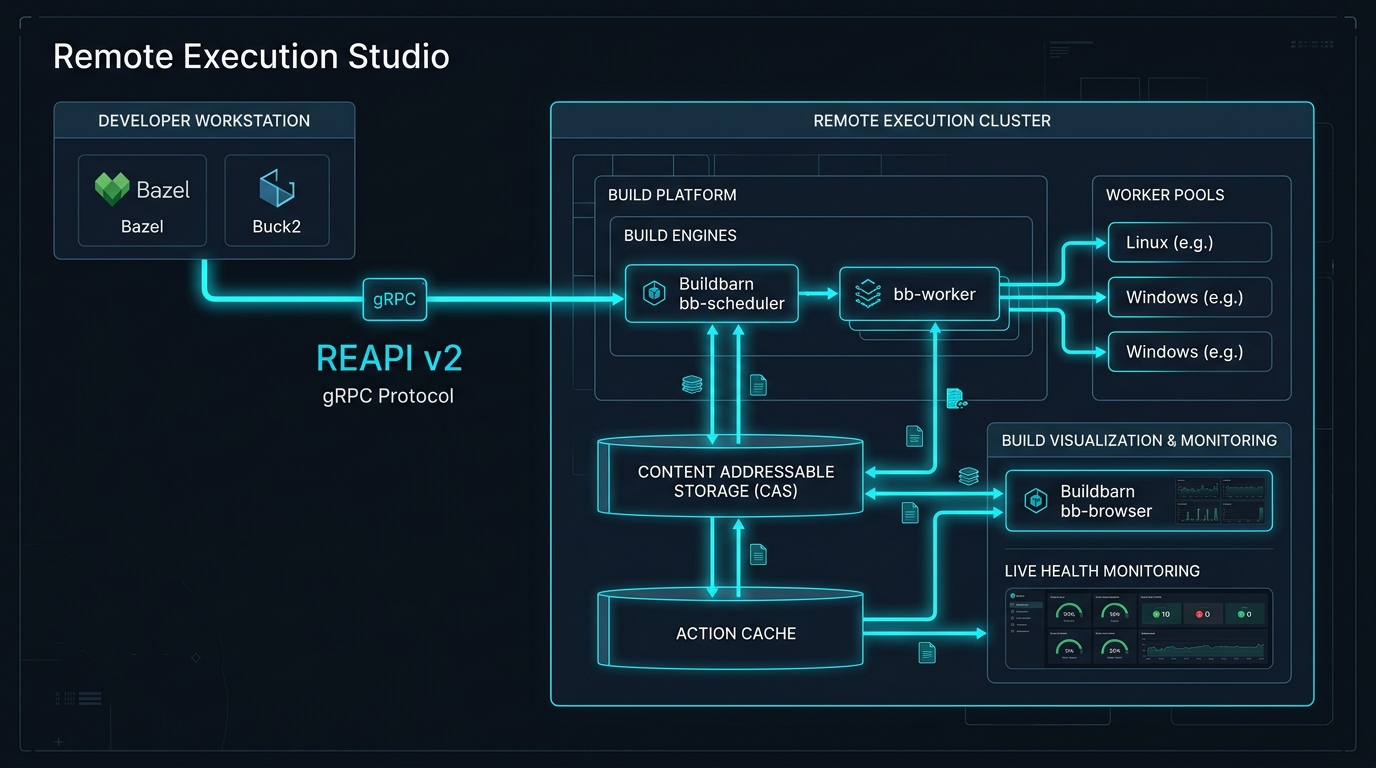
Instead of wrestling with YAML manifests, gRPC connection strings, and arcane build flags, developers and platform engineers use Remote Execution Studio to configure, verify, and consume remote execution clusters in seconds:
- Single-Click REAPI Connection: Connect to your organization’s Buildbarn, NativeLink, or BuildGrid cluster with zero manual YAML writing.
- Automated Client Flag Synthesis: Instant, push-button generation of production-ready
.bazelrcand.buckconfigfiles with optimal caching strategies (--remote_download_minimal). - Live Cluster Health Telemetry: Direct, non-invasive gRPC health probes against CAS, Action Cache, and Scheduler endpoints with live latency metrics.
- Worker Pool Visualization: Visual inventory of available execution worker pools, operating systems, CPU instruction sets, and container images.
- Dual-State Knowledge Graph Integration: Clusters are modeled as semantic
robos:RemoteExecutionClusternodes in.robos/kgraphs/devops/package.jsonldand verified with strict W3C SHACL constraints. - Zero Plaintext Credentials: All TLS client certificates and auth tokens are secured in the local UNIX password store (
pass) with GPG encryption.
Open Standards: Remote Execution API (REAPI v2) Without Vendor Lock-In
RobOS rejects proprietary build SaaS traps. Remote Execution Studio is built entirely on the open-source Remote Execution API standard (REAPI v2) maintained by the Linux Foundation and Bazel open-source community (build.bazel.remote.execution.v2).
Because RobOS models clusters using the generic robos:RemoteExecutionCluster ontology, your organization can switch between or combine any open-source or commercial REAPI provider without changing a single line of application code or developer workflow:
| Provider Engine | Architecture Highlights | Best Used For | RobOS Support |
|---|---|---|---|
| Buildbarn | Modular Go-based microservice architecture (bb-storage, bb-scheduler, bb-worker, bb-browser) with petabyte-scale CAS sharding. | Enterprise distributed builds, large multi-language monorepos, and high-concurrency CI clusters. | Native First-Class Provider & Config Synthesizer |
| NativeLink | High-performance, memory-safe REAPI caching and execution engine written in Rust. | Ultra-low-latency remote caching, edge builders, and memory-constrained environments. | Native Config Synthesizer (nativelink.json5) |
| BuildGrid | Python-based REAPI reference implementation with flexible backend storage adapters. | Specialized build pipelines and experimental toolchain development. | Supported via REAPI v2 gRPC |
| BuildBuddy | Commercial & self-hosted REAPI server with rich web analytics. | Teams seeking managed hosting with enterprise SSO. | Supported via REAPI v2 gRPC |
Instant Client Configuration: Bazel & Buck2
One of the biggest friction points for developers is configuring their local build tools to talk to the remote cluster. Copying .bazelrc files between team members frequently leads to syntax errors, wrong endpoints, or missing flags that silently disable caching.
Remote Execution Studio eliminates this with push-button build client synthesis:
1. Production .bazelrc Generation
With one click, Remote Execution Studio inspects the active cluster in the Knowledge Graph and generates a complete, optimized .bazelrc:
# Auto-generated by RobOS Remote Execution Studio
# Cluster: Acme Production Buildbarn REAPI Cluster
# Standard: REAPI v2 (Protocol: gRPC)

build --remote_executor=grpc://re-execution.buildbarn.internal:8980
build --remote_cache=grpc://re-cas.buildbarn.internal:8980
build --remote_instance_name=main
build --remote_default_exec_properties=OSFamily=linux
build --remote_download_minimal
build --bes_backend=http://re-browser.buildbarn.internal:7984
2. Production .buckconfig Generation
For teams using Meta’s high-performance Buck2 build system, the studio synthesizes a verified [buck2_re_client] configuration:
# Auto-generated by RobOS Remote Execution Studio
# Cluster: Acme Production Buildbarn REAPI Cluster

[buck2_re_client]
engine_address = grpc://re-execution.buildbarn.internal:8980
action_cache_address = grpc://re-cas.buildbarn.internal:8980
cas_address = grpc://re-cas.buildbarn.internal:8980
instance_name = main
Developers simply click “Apply to Workspace” or copy the snippet directly into their repo root.
Semantic Modeling & W3C SHACL Validation
In RobOS, remote build clusters are not ephemeral environment variables or loose JSON blobs. They are first-class citizens of the RobOS Dual-State Knowledge Graph:
- Ontology Class:
robos:RemoteExecutionClusterin thedevopspackage (.robos/kgraphs/devops/package.jsonld). - Validation Shape: Validated against
urn:robos:shape:RemoteExecutionClusterShapeinpackages/robos-graph/lib/shacl-validator.json every Git commit. - Documentation: Formally documented in the Remote Execution Cluster Schema.
{
  "@id": "urn:robos:remote-execution:acme-buildbarn-cluster",
  "@type": [
    "robos:RemoteExecutionCluster",
    "robos:RemoteBuildCluster",
    "oslc:Resource"
  ],
  "dcterms:title": "Acme Production Buildbarn REAPI Cluster",
  "robos:protocol": "REAPI_v2",
  "robos:provider": "buildbarn",
  "robos:instanceName": "main",
  "robos:executionEndpoint": "grpc://re-execution.buildbarn.internal:8980",
  "robos:casEndpoint": "grpc://re-cas.buildbarn.internal:8980",
  "robos:actionCacheEndpoint": "grpc://re-cas.buildbarn.internal:8980",
  "robos:browserEndpoint": "http://re-browser.buildbarn.internal:7984",
  "robos:status": "active"
}
If an engineer attempts to register a cluster without a valid CAS endpoint or with an invalid protocol, the RobOS SHACL engine catches the discrepancy immediately before deployment.
Summary: Velocity Without the Pain
| Traditional Remote Execution | RobOS Remote Execution Studio |
|---|---|
| 2-4 weeks of DevOps wrestling to stand up microservices and mTLS. | Single-click visual explorer with instant REAPI v2 discovery. |
Fragmented wiki pages with out-of-date .bazelrc snippets. | Push-button generation of optimized Bazel and Buck2 configs. |
| Mysterious build cache misses and unknown worker pool failures. | Real-time endpoint health probes and latency telemetry. |
| Secrets and certificates scattered across plaintext developer files. | Encrypted locally in UNIX pass with GPG integration. |
| High maintenance overhead leading most teams to give up. | Zero-overhead, production-grade build acceleration for all. |
Next Steps
- Explore RobOS Main Wins: Return to the Main Wins executive overview.
- Remote Execution Cluster Schema: Inspect the formal W3C SHACL shape and JSON-LD schema specification.
- DevOps Security & Password Store: Learn how credentials are encrypted in UNIX
pass. - Declarative GitOps Storage: Discover how architecture compiles into Kubernetes manifests.