RobOS Main Wins: Core Innovations & Strategic Advantages
The core architectural breakthroughs and engineering advantages that separate RobOS from traditional IDEs and coding assistants, transforming software engineering from manual boilerplate into visual proof-of-work, open standards, and Knowledge Graph-First generation.
Table of contents
- Executive Overview: Why RobOS?
- 1. 🎥 Autonomous E2E-Driven Dev with Video Proof-of-Work (AI Proves Its Work)
- 2. 📋 Interactive Task Templates & Multi-Domain Planning
- 3. 🌐 Universal Web, API & Microservice Client Suite (REST, gRPC, GraphQL, & Streaming)
- 4. 🗄️ Unified Data Source Client & Management GUI (Relational, NoSQL, & Cloud Stores)
- 5. 🤖 Universal Agent-Agnostic Framework & Algorithmic Independence
- 6. 👤 Ephemeral Linux Agent Sandboxes & Display Bridging (Zero Machine Clutter)
- 7. ☁️ DevOps Account Integrations & GPG Password Store (
pass) - 8. ⚡ Remote Execution Studio & REAPI v2 (Distributed Builds Without the Overhead)
- 9. 🧬 KGraph-First Application Generation & Modular Architecture
- 10. 🧠 Dual-State SDLC Knowledge Graph (Today vs. Tomorrow)
- 11. ⚡ 100% Declarative GitOps Storage & Zero-YAML Synthesis (
.robos/) - Summary Comparison: RobOS vs. Traditional Tools
- Next Steps
Executive Overview: Why RobOS?
Traditional IDEs and AI coding tools give you autocompletions, chat sidebars, and code popups. While they generate isolated lines of code quickly, they create three severe bottlenecks:
- Hallucinations & Review Fatigue: Agents claim “Task complete!” without proving anything, forcing developers into exhausting manual verification loops.
- Vendor Lock-In & Model Capture: Workflows are trapped within proprietary LLM silos with incompatible prompt rules and rigid pricing.
- Context Blindness & Machine Pollution: Tools lack awareness of system-wide contracts, while autonomous agents litter developer workstations with leftover files and stray ports.
RobOS replaces this fragmented paradigm with an autonomous engineering operating system, a 30+ native developer application suite, and an executable semantic blueprint. In RobOS, software development is anchored around RobOS Main Wins prioritized from immediate developer experience to foundational semantic compilation:
🎥 1. Video Proof-of-Work
No code reaches human review without automated visual proof: 1080p narrated video walkthroughs and Piper TTS neural voiceovers verifying every UI and API assertion.
📋 2. Interactive Multi-Domain Planning Studio
Interactive web form templates across Web APIs, Frontend SPAs, games, libraries, and cloud infra, with custom template builders and bidirectional GitHub Issues & Jira synchronization.
🌐 3. Universal Web & API Clients
RobOS provides native web clients and management GUIs for REST (Git-backed .bru collections), Protobuf gRPC, GraphQL introspection, and real-time streaming protocols synchronized with architecture contracts.
🗄️ 4. Unified Data Sources GUI
Native data source client and management GUI across Relational (PostgreSQL, MySQL, Oracle), NoSQL (MongoDB, Redis), Search, and Cloud Object Stores directly connected to the Knowledge Graph.
🤖 5. Agent-Agnostic Open Framework
Built on open global standards (OSLC, W3C JSON-LD, SHACL, MCP) implemented in the open. Zero algorithm lock-in: dynamically dispatches the right agent to the right task for optimal value and cost.
👤 6. Ephemeral In-Memory Sandboxes
Agents execute in isolated Linux profiles mounted in high-speed RAM (tmpfs) on private virtual displays. Zero leftover files, zero stray ports, and complete credential isolation.
☁️ 7. DevOps Security & Password Store
Onboarding wizards for 25+ providers across 7 categories. Zero plaintext secrets in Git: credentials are encrypted directly into the UNIX password store (pass) with GPG.
⚡ 8. Remote Execution Studio
Most companies don't use remote build servers because they're too hard to set up and manage. RobOS provides zero-overhead Bazel, Buck2, and Buildbarn REAPI v2 distributed builds.
🧬 9. KGraph-First App Generation
Auto-generates full applications across 9 archetypes from schema-validated, modular namespaced package stores (.robos/kgraphs/) with multi-repo composition and Git-tag version pinning.
🧠 10. Dual-State SDLC Knowledge Graph
Compares World 1 (Production main) against World 2 (Feature Branch) for pre-code blast radiuses. Provides multi-level agent context inheritance (Global, Company, Org, Team, Repo) to eliminate duplicate skills.
⚡ 11. 100% Declarative GitOps Storage
System topology, data sources, and contracts live in clean Git files under .robos/. Modifying architecture automatically synthesizes ready-to-deploy Kubernetes manifests and Helm charts.
1. 🎥 Autonomous E2E-Driven Dev with Video Proof-of-Work (AI Proves Its Work)
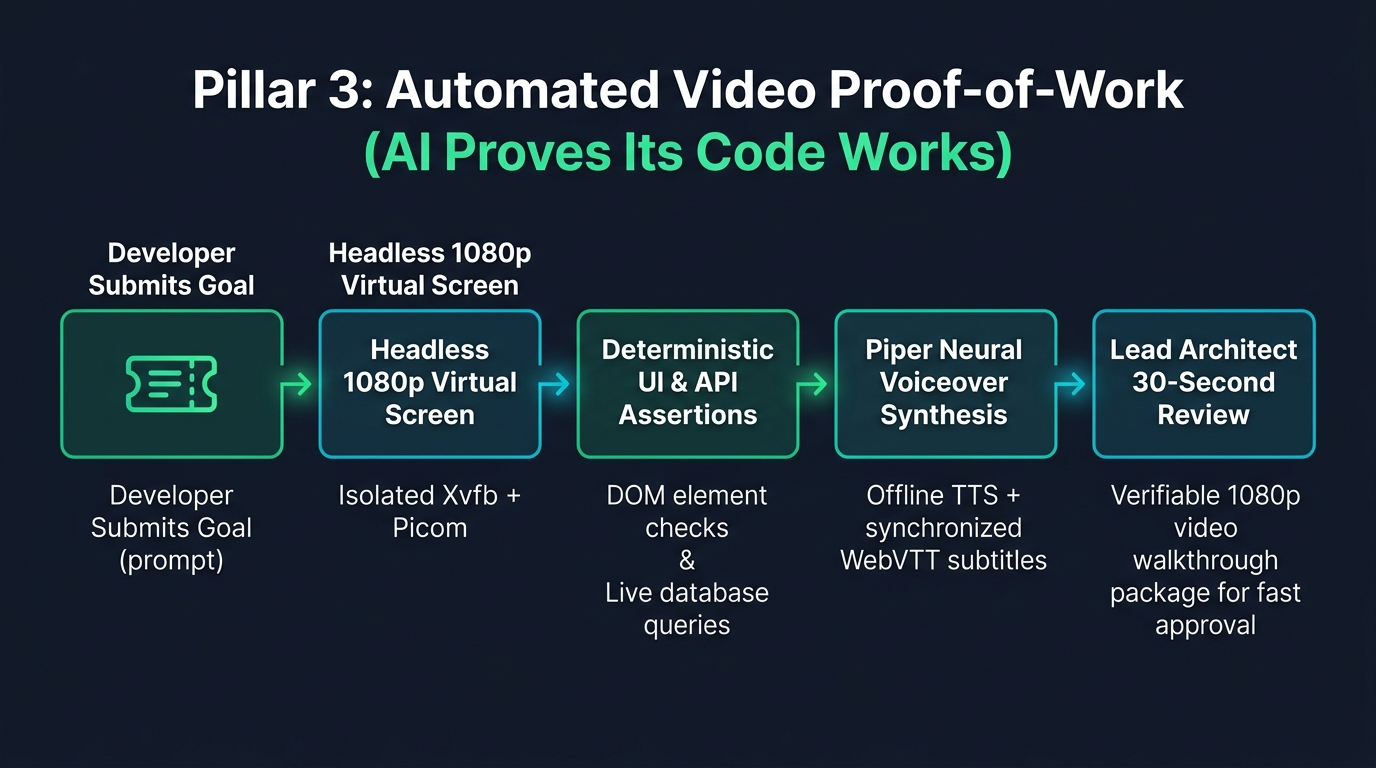
In RobOS, no code reaches human review on trust alone. Hallucinations and review fatigue are solved through verifiable proof-of-work packages:
Key Capabilities
- Deterministic Assertions: The test harness interacts with real DOM elements, fills out forms, verifies database mutations, and validates HTTP status codes.
- Synchronized 1080p Video: Records smooth 1080p video demonstrating the application executing end-to-end.
- Local Neural Voiceovers (Piper TTS): Generates clear, spoken audio explanations using offline neural text-to-speech synchronized with WebVTT subtitle tracks.
- 30-Second Human Approvals: Lead architects review features in under 30 seconds by watching the walkthrough rather than spending 20 minutes manually cloning, building, and seeding test data.
👉 Read the Complete Guide: Video Proof-of-Work →
2. 📋 Interactive Task Templates & Multi-Domain Planning
Bridging high-level product intent and concrete engineering implementation is often the weakest link in SDLC automation. The RobOS Task Planner provides a structured, multi-domain planning studio:
Key Capabilities
- Comprehensive Interactive Web Form Templates: Purpose-built templates spanning Web APIs (OpenAPI / Spring Boot), Frontend SPAs (React / Vue), Godot / Unity video games, Java libraries, Mobile apps, Knowledge Graph schemas, and Cloud infrastructure.
- Custom Template Authoring Studio: Visual builder empowering teams to define custom organizational task forms with input validations, default fields, and automated task breakdowns.
- Bidirectional Issue Tracker Sync: Native two-way synchronization with GitHub Issues and Jira Cloud/Server, as well as the hermetic RobOS Local Task Server.
- Phased DAG Task Synthesis: Converts high-level architectural requirements into a Directed Acyclic Graph (DAG) with milestone checkpoints and automated agent execution dispatch.
👉 Read the Complete Guide: Interactive Multi-Domain Planning Studio →
3. 🌐 Universal Web, API & Microservice Client Suite (REST, gRPC, GraphQL, & Streaming)
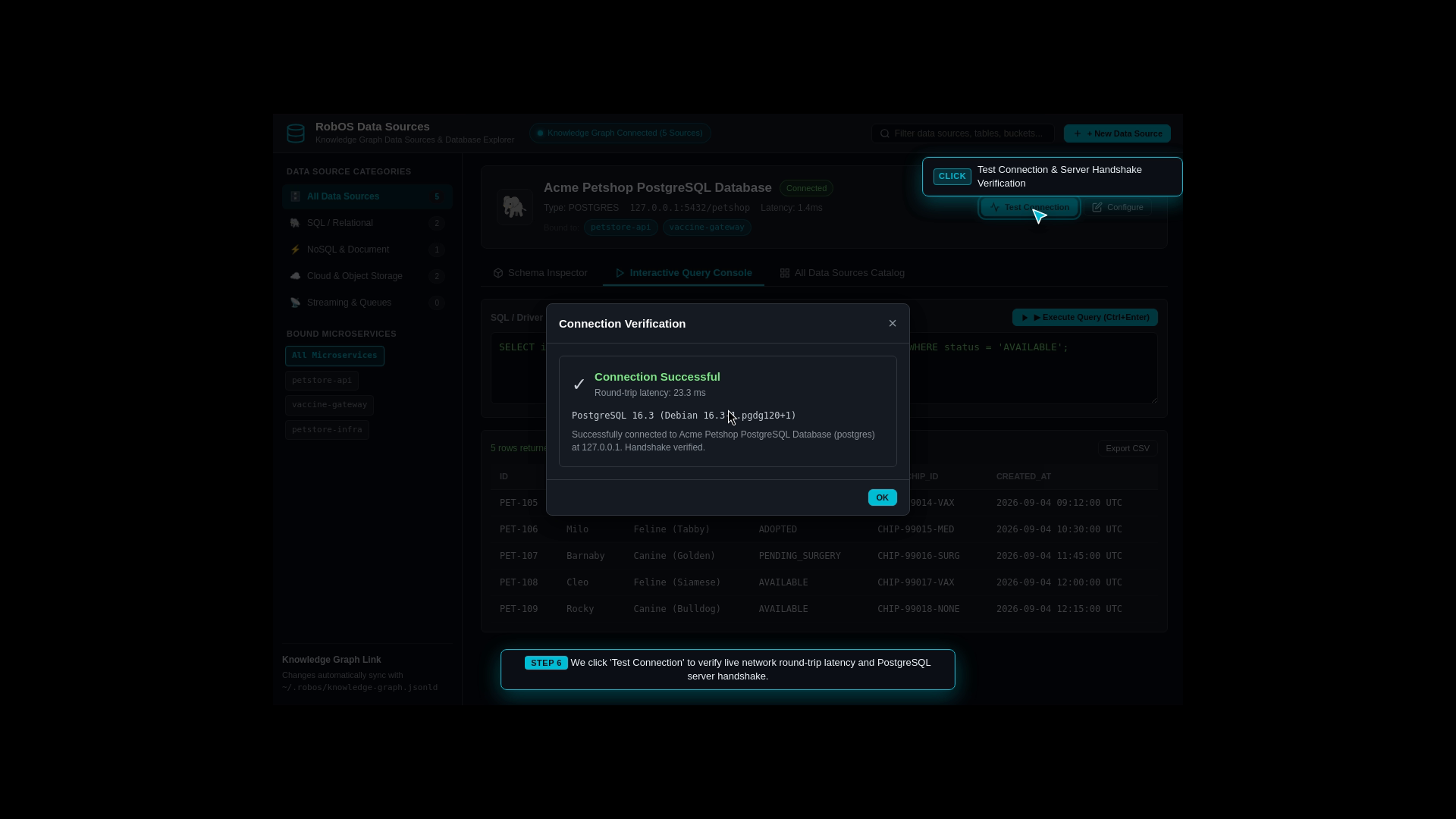
In software development, “having a REST client” is not a big win. The strategic Big Win is that RobOS provides a universal web, API & microservice client suite and management GUI across REST, gRPC, GraphQL, and real-time streaming protocols directly synchronized with architecture contracts.
RobOS eliminates SaaS lock-in, proprietary cloud vaults, and electron bloat from Postman or Insomnia by committing all collections as Git-backed plain text files versioned with your codebase.
Key Capabilities
- Git-Backed REST API Client: Bruno-compatible
.bruplain text format versioned directly inside your Git repository alongside code. - gRPC Client with Protobuf Reflection: Dynamic service discovery, Protobuf payload authoring, and server streaming inspection without manual compilation.
- GraphQL Introspection Client: Live schema explorer, query/mutation composer, and variable execution runner.
- Microservice BDD Verification: Run entire test suites against live microservices with assertion matrices and automated response checks.
👉 Read the Complete Guide: Universal Web & API Clients Suite →
4. 🗄️ Unified Data Source Client & Management GUI (Relational, NoSQL, & Cloud Stores)
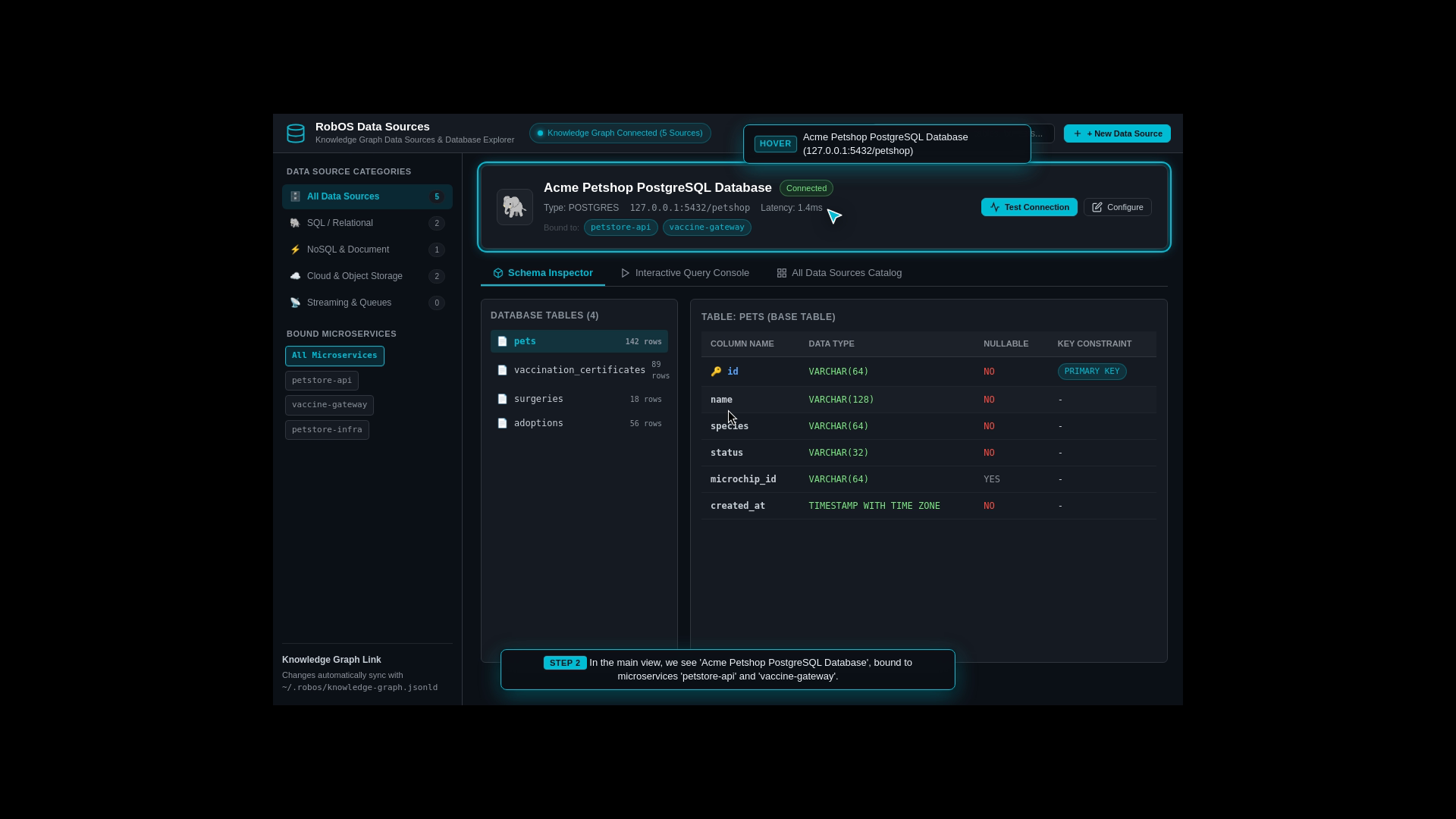
Similarly, “having a database” is unremarkable. The strategic Big Win is that RobOS provides a native, unified data source client and management GUI across Relational (PostgreSQL, MySQL, Oracle), NoSQL (MongoDB, Redis), Search, and Cloud Object Stores directly connected to the Knowledge Graph.
Engineers no longer need heavy, memory-hungry, disconnected third-party tools like DBeaver, DataGrip, or MongoDB Compass running alongside their IDE.
Key Capabilities
- Relational DB Manager: DBeaver-grade SQL console, schema inspector, table data grid, foreign key navigation, and DDL generation supporting PostgreSQL, Oracle, and MySQL.
- NoSQL DB Manager: MongoDB Compass and RedisInsight-inspired document viewer, key-value inspector, TTL editor, and query runner.
- Unified Data Sources Explorer: Comprehensive view linking relational databases, Kafka streaming topics, and AWS S3 contract vaults directly into system topology nodes.
- Automated Schema Synchronization: Local database schemas, migrations, and DDL definitions automatically synchronize with KGraph entity models.
👉 Read the Complete Guide: Unified Data Sources Management Suite →
5. 🤖 Universal Agent-Agnostic Framework & Algorithmic Independence
Proprietary coding assistants trap engineering teams in closed vendor ecosystems with incompatible prompt syntax and rigid model dependencies. RobOS is completely model- and agent-agnostic:

Key Capabilities
- Global Open Standards: Built entirely on OASIS OSLC Core 3.0, W3C JSON-LD 1.1, W3C SHACL, Model Context Protocol (MCP), OpenAPI 3.1, Protobuf, and UNIX
pass. - Right Agent for the Right Task: Dynamic task-to-value routing assigns lightweight tasks (linting, test stubs) to ultra-fast models (Gemini 2.5 Flash, Claude Haiku 4.5, local Ollama) and complex architectural refactors to frontier reasoning models (Claude Sonnet 5, OpenAI o3 / Reasoning), optimizing value and slashing token costs.
- Universal Skill Marketplace: Skills in
plugins/robos/skills/follow cross-agent standards, executing identically in Claude Code, OpenAI Codex, Google Antigravity, GitHub Copilot CLI, Gemini CLI, Cursor, and Windsurf. - Sovereign & Air-Gapped Execution: Connect to local Ollama or vLLM backends with zero external network telemetry for strict regulatory compliance.
👉 Read the Complete Guide: Agent-Agnostic Open Framework →
6. 👤 Ephemeral Linux Agent Sandboxes & Display Bridging (Zero Machine Clutter)
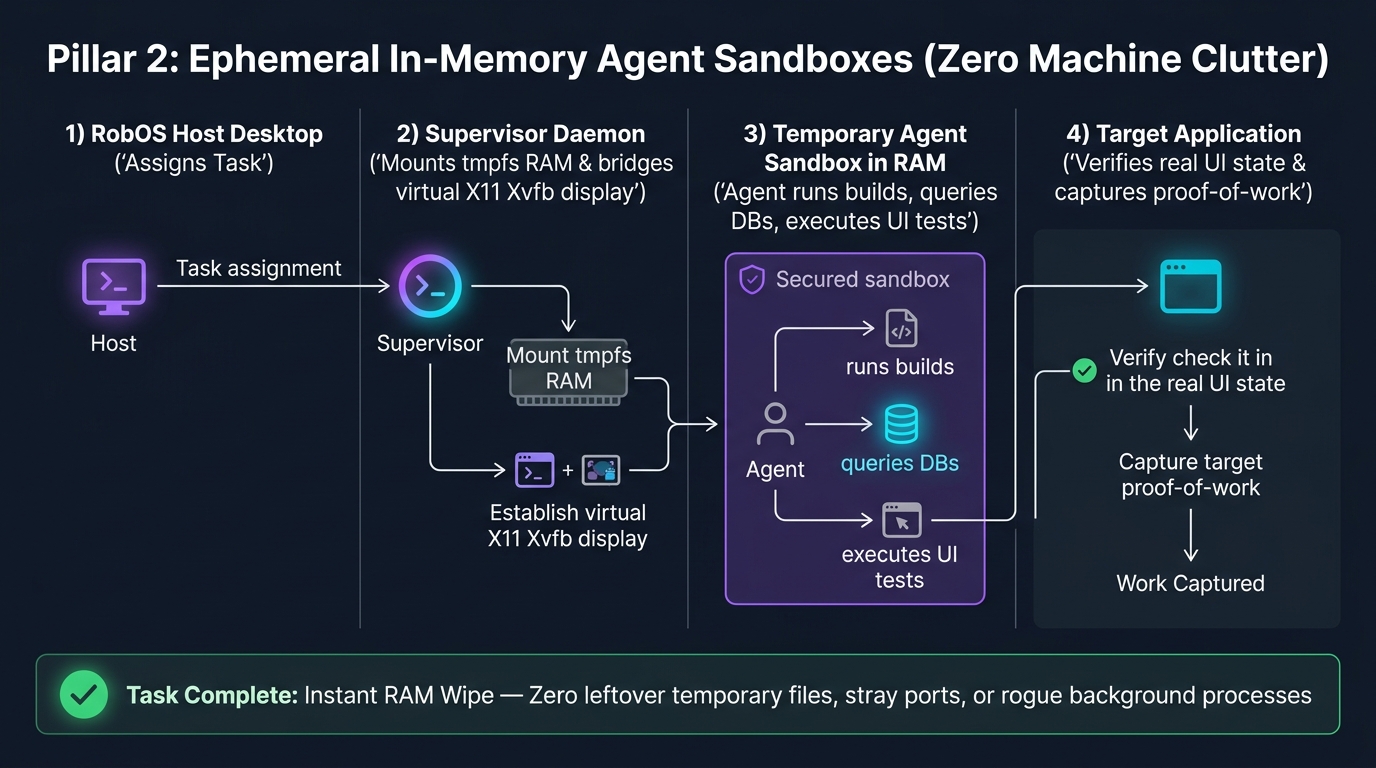
Letting autonomous AI agents execute terminal commands directly in your primary user account is dangerous and messy. RobOS dynamically provisions hermetic, disposable in-memory agent sandboxes:
Key Capabilities
- Zero-Residue In-Memory Storage: Agent workspaces live entirely in high-speed RAM (
tmpfs). When a task finishes or is cancelled, memory is wiped clean with zero orphanednode_modules, stray Docker containers, or lingering cache files. - Virtual Display Isolation (
Xvfb+ Picom): Automated visual tests and browser sessions run on private headless displays, leaving your active monitor and workflow completely uninterrupted. - Live DOM & UI Inspection: Dedicated debug ports (
19100–19183) allow agents to inspect real DOM trees, verify styles, and test UI components with sub-pixel precision. - Scoped Credential Isolation: Agents execute under scoped ephemeral user accounts (
/home/agent-...), shielding your private SSH keys, GPG keys, and personal shell dotfiles.
👉 Read the Complete Guide: Ephemeral Agent Sandboxes →
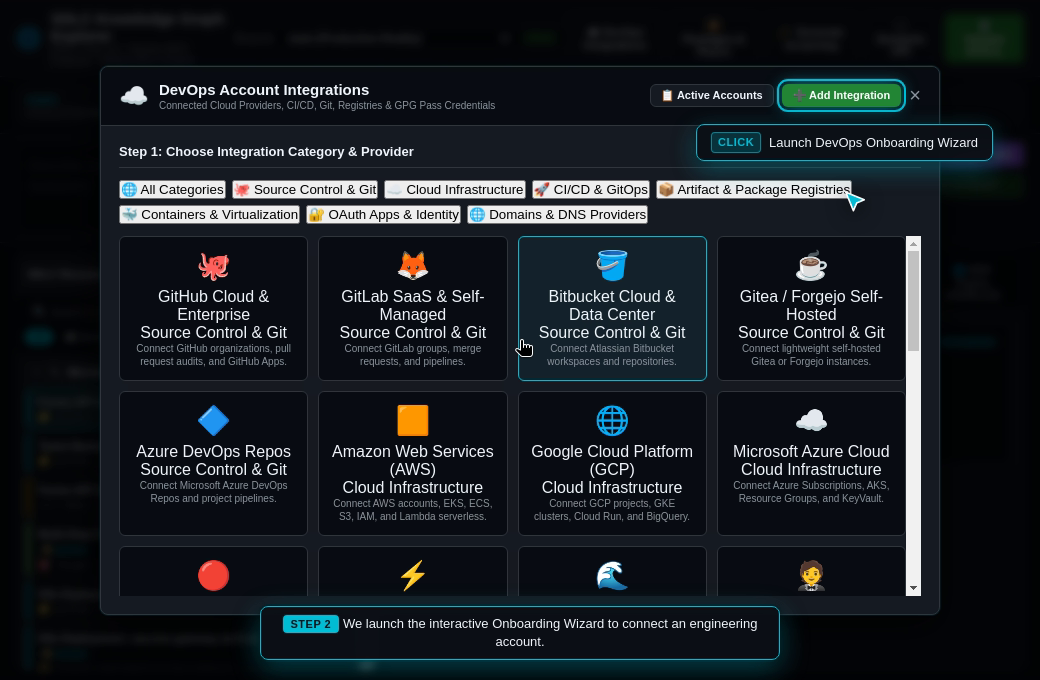
7. ☁️ DevOps Account Integrations & GPG Password Store (pass)
Managing credentials and cloud access across multi-cloud environments is notorious for credential leakage. RobOS provides interactive onboarding wizards across 7 categories and 25+ providers with zero plaintext credentials:
Key Capabilities
- 25+ Supported Providers: Source Control (GitHub, GitLab, Bitbucket), Cloud Infrastructure (AWS, GCP, Azure), CI/CD & GitOps (ArgoCD, Jenkins), Package Registries (Artifactory, Docker Hub), Containers & Virt (Kubernetes, Podman, VMware), OAuth & Identity (Okta, Azure AD), and Domains & DNS (GoDaddy, Route 53).
- Zero Plaintext Secrets in KGraph: Sensitive API tokens, private keys, and passwords are never written to the Knowledge Graph.
- UNIX Password Store (
pass) GPG Encryption: Secrets are encrypted and saved directly into the local UNIX password store (pass) at~/.password-store/devops/<category>/<provider>/<account-slug>/<key>.gpg. - First-Class Reference Nodes: The KGraph stores first-class
robos:PassCredentialreference nodes declaringrobos:passPath, linked torobos:DevOpsIntegrationnodes viarobos:hasCredential.
👉 Read the Complete Guide: DevOps Security & GPG Password Store →
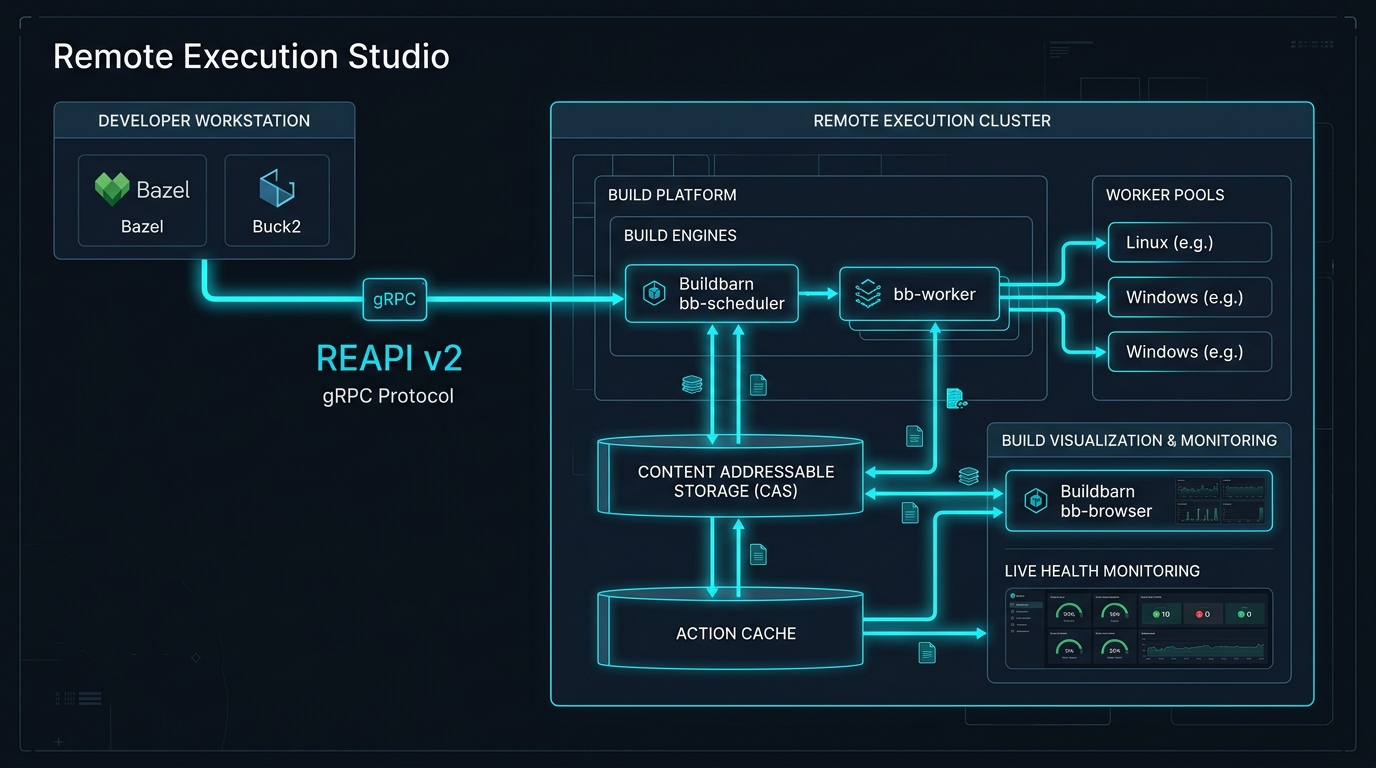
8. ⚡ Remote Execution Studio & REAPI v2 (Distributed Builds Without the Overhead)
Rebuilding multi-gigabyte codebases from scratch is a massive productivity killer. Clean builds in C++, Rust, Go, or monorepo TypeScript easily take 20 to 60 minutes. Yet, the overwhelming majority of engineering companies never use remote build servers because traditional clusters (Buildbarn, NativeLink, Bazel remote caching) are notoriously hard to set up, understand, and manage:
- Too Hard to Set Up: Deploying 5+ distributed microservices (
bb-storage,bb-scheduler,bb-worker,bb-runner,bb-browser), configuring mTLS certificates, tuning raw NVMe block allocations, and writing Kubernetes StatefulSets. - Too Hard to Understand: Deciphering Merkle tree digests, Content Addressable Storage (CAS), Action Cache (AC), hermetic inputs, and platform properties.
- Too Hard to Manage: Reconciling worker pools with heterogeneous OS/ISA combinations, managing runner sandboxes, and maintaining sprawling
.bazelrcor.buckconfigfiles across hundreds of laptops.
RobOS replaces this friction with Remote Execution Studio—Use this instead:
Key Capabilities
- Single-Click REAPI Connection: Connect to Buildbarn, NativeLink, or BuildGrid clusters with zero manual YAML writing.
- Push-Button Client Synthesis: Automatically generate production
.bazelrcand.buckconfigfiles with optimal caching flags (--remote_download_minimal). - Live Health Telemetry: Direct gRPC health probing for CAS, Action Cache, and Scheduler endpoints with live latency metrics.
- Zero-Guesswork Worker Pools: Inspect declared OS families, CPU architectures, and container runner images directly from the GUI.
- Semantic KGraph Modeling: Clusters are modeled as canonical
robos:RemoteExecutionClusternodes validated against W3C SHACL shapes. - Zero Plaintext Secrets: TLS client certificates and auth tokens are secured in the local UNIX password store (
pass) with GPG.
👉 Read the Complete Guide: Remote Execution Studio & REAPI v2 →
9. 🧬 KGraph-First Application Generation & Modular Architecture
In modern software engineering, developers rely on contracts to eliminate manual boilerplate:
- An OpenAPI 3.1 specification generates typed REST client SDKs, server stubs, and API gateway routing.
- A Protobuf definition generates gRPC stubs and binary serializers.
- An SQL DDL schema generates ORM entity models and migration scripts.
RobOS elevates this principle to the entire software application:
If an API contract can automatically generate a client, a schema-validated Knowledge Graph can automatically generate an entire application.
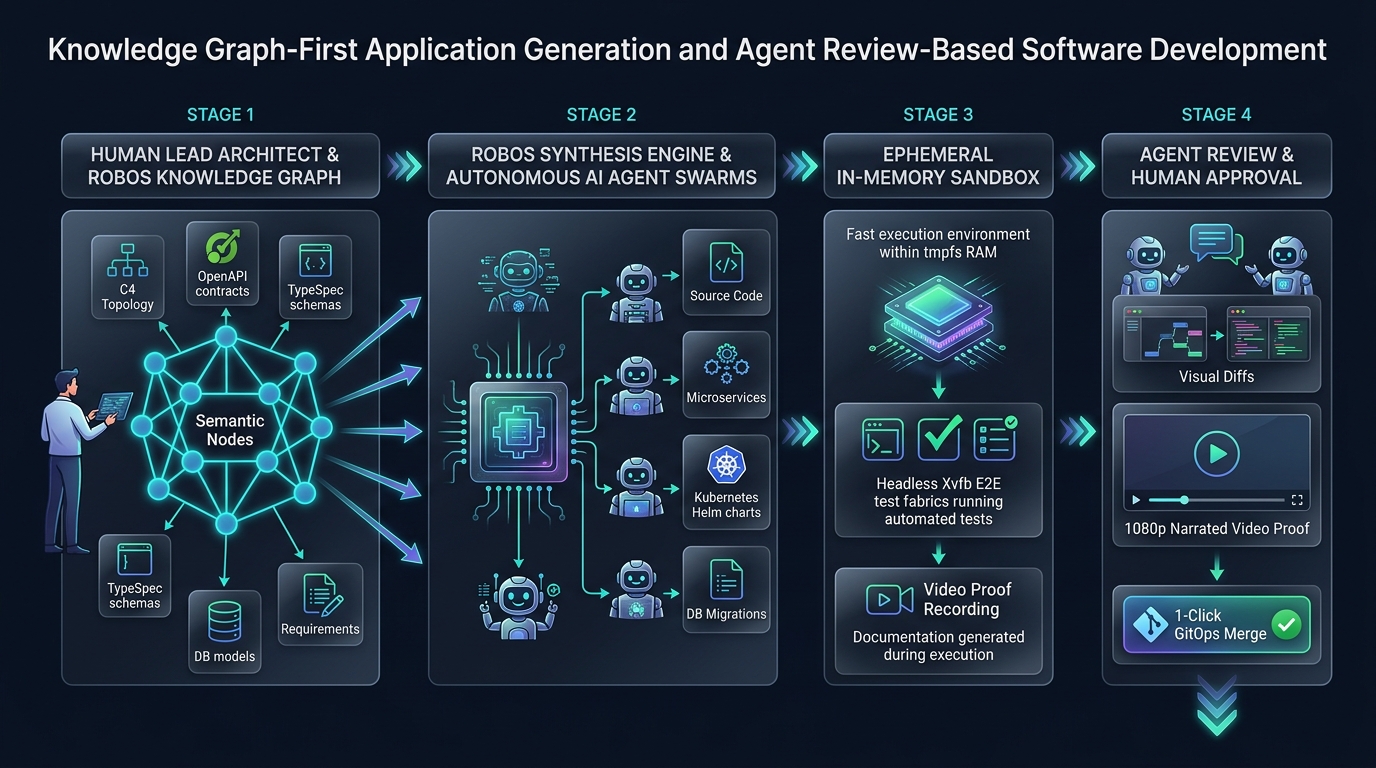
How It Works
- Architect the System in Modular Package Stores: Define or import application nodes into Modular KGraph Packages under
.robos/kgraphs/<pkg>/package.jsonldindexed by.robos/kgraph.yaml(core-platform,services,applications,organization,devops,learning). Eliminates Git merge conflicts and supports multi-repo composition with Git-tag version pinning (e.g.v1.2.0). - Declare Archetypes, Contracts, and Schemas: Specify the archetype across 9 supported classes (
robos:Microservice,robos:FrontEndApp,robos:DesktopApp,robos:PCGame,robos:MobileGame,robos:ConsoleApp,robos:MobileApp,robos:DataPipeline,robos:Library), data entities in Microsoft TypeSpec, and database connections. - Auto-Generate the Application: The RobOS synthesis engine and autonomous agent swarms compile the graph into idiomatic polyglot project scaffolding, domain models, controllers, migrations, devcontainers, and consumer contract tests.
- Agent Review-Based Governance: The human lead architect reviews the synthesized application diffs against KGraph requirements and inspects the narrated video proof-of-work before approving deployment.
👉 Read the Complete Guide: KGraph-First Application Generation & Modular Architecture →
10. 🧠 Dual-State SDLC Knowledge Graph (Today vs. Tomorrow)
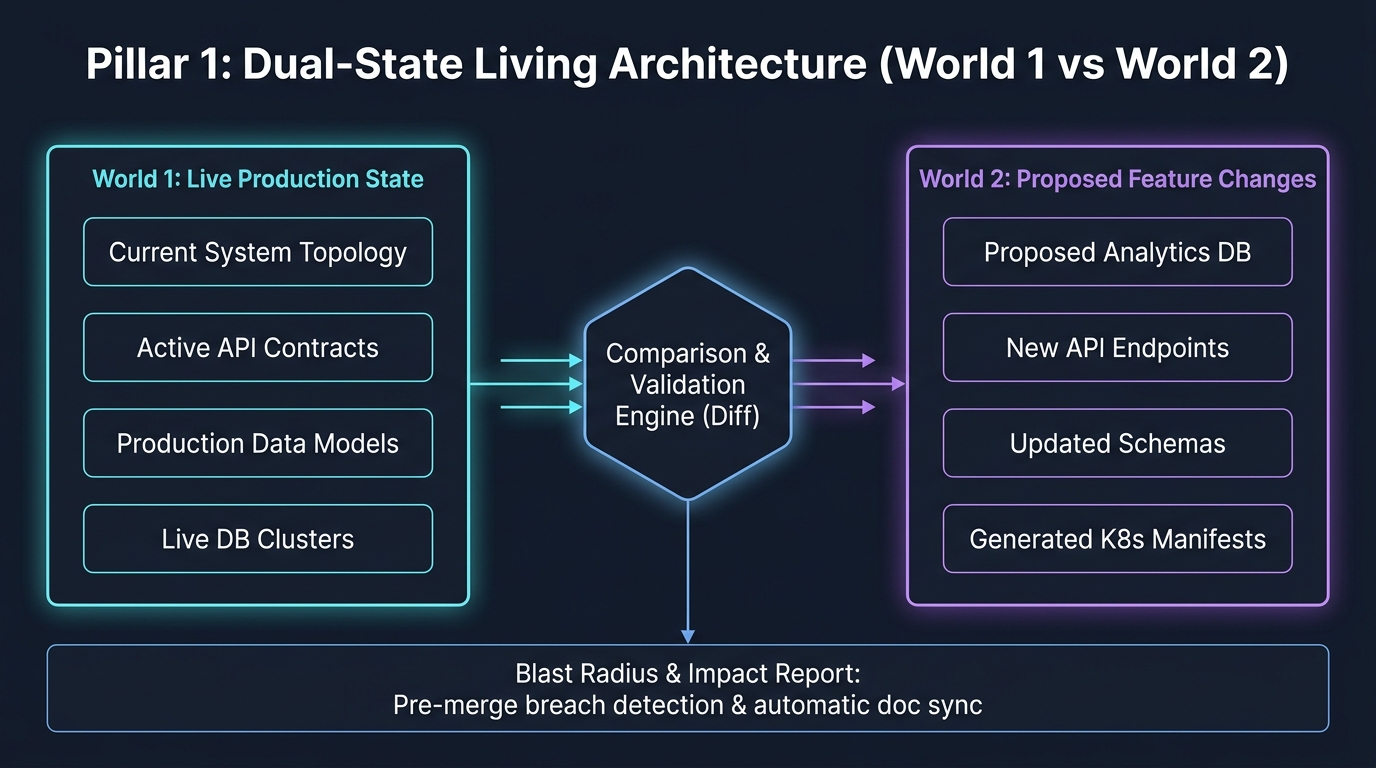
Traditional developer tools are myopic: they only understand isolated source files on disk. RobOS maintains an executable, connected architecture knowledge graph based on OASIS OSLC Core 3.0, W3C JSON-LD 1.1, and W3C SHACL:
Key Capabilities
- World 1 (Live Production
main): Tracks currently deployed microservices, active API contracts, and production database tables. - World 2 (Feature Branch): Models what the system will look like once your pull request or spike is merged.
- Automated Blast Radius Calculation: When an AI agent or developer alters an endpoint, schema, or entity model, RobOS immediately flags which downstream microservices, mobile apps, or web frontends are affected before code is written.
- Hierarchical Agent Context & Multi-Level Rules Inheritance: Specify agent context, skills, and architectural rules at global, company/enterprise, organization (e.g., Apache), team, and repository levels. Avoids duplicate skills, prompt rules, and
.cursorrulesfiles by dynamically compiling the effective context whenever an agent session launches. - Living Documentation Continuous Sync: Whenever graph objects change, RobOS automatically discerns impacts and synchronizes documentation (
docs/index.md,README.md,docs/project-plan/) and training curriculums in continuous lockstep. - Open-Standard Ontologies: Strict OASIS OSLC Core 3.0 types (
oslc_rm:Requirement,oslc_cm:ChangeRequest,oslc_am:Resource,oslc_qm:TestPlan) with W3C SHACL shape validation.
👉 Read the Complete Guide: Dual-State Knowledge Graph →
11. ⚡ 100% Declarative GitOps Storage & Zero-YAML Synthesis (.robos/)
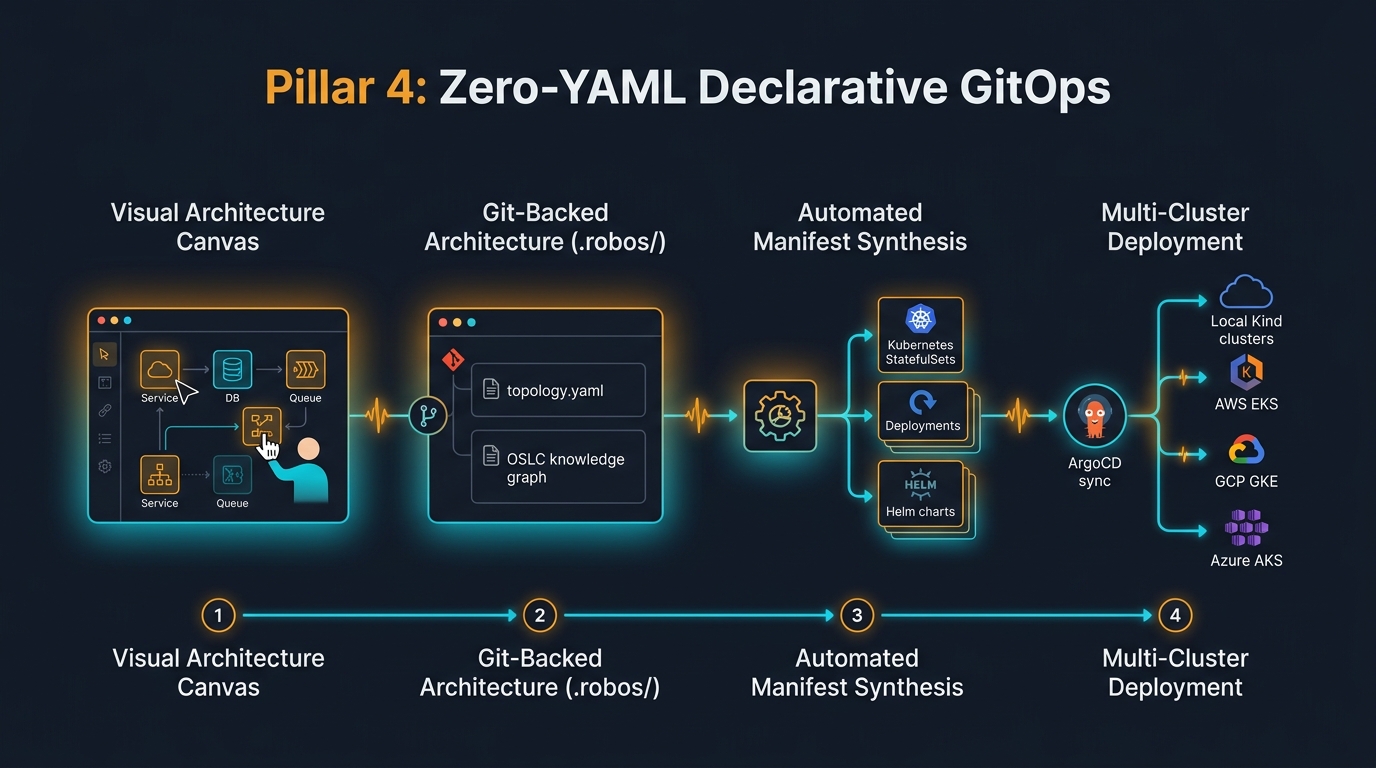
RobOS eliminates YAML sprawl and configuration fragility. All architecture, contracts, topologies, and data sources live in standard, human-readable Git files under .robos/:
Key Capabilities
- Instant Cloud Manifest Synthesis: Adding a PostgreSQL, Redis, Kafka, or microservice node to the visual architecture canvas automatically synthesizes ready-to-deploy Kubernetes StatefulSets, Deployments, and Helm charts.
- Local & Enterprise Clusters: Connect to local Kind clusters for instant local debugging, or target enterprise clouds (AWS EKS, Google Cloud GKE, Azure AKS) with real-time pod log streaming and ArgoCD GitOps reconciliation.
- Git-Backed API Collections: API endpoints and test suites are stored directly in your repository as plain-text files (
.bru), version-controlled alongside application code. - Zero Vendor Lock-In: Everything is stored in open, declarative formats: Modular KGraph Packages (
.robos/kgraphs/),.robos/topology.yaml,.robos/packages.yaml, and.robos/teams.yaml.
👉 Read the Complete Guide: Declarative GitOps Synthesis →
Summary Comparison: RobOS vs. Traditional Tools
| Capability | Traditional IDEs & AI Plugins | RobOS Autonomous Developer OS |
|---|---|---|
| 1. Verification & Review | “Trust me, it works” walls of text | Headless 1080p Video Proof-of-Work & Neural Voice |
| 2. Task Planning | Ad-hoc tickets or markdown checklists | Interactive Domain Templates & Phased DAG Planning |
| 3. Web & API Clients | SaaS-locked apps (Postman, Insomnia) | Universal Web, API & Microservice Suite (REST, gRPC, GraphQL) |
| 4. Data Source Management | Heavy external tools (DBeaver, DataGrip) | Native Relational DB, NoSQL, & Data Sources Manager |
| 5. AI Model & Agent Freedom | Locked to a single proprietary LLM/vendor | Universal Agent-Agnostic Framework (OSLC, MCP, Open Standards) |
| 6. Agent Execution Safety | Host user directory pollution | Hermetic In-Memory RAM Sandboxes (tmpfs) |
| 7. Credential Security | Plaintext .env and config files | GPG-Encrypted UNIX Password Store (pass) |
| 8. Build Acceleration | 30+ min local builds & complex REAPI setups | Remote Execution Studio: Zero-Overhead Bazel, Buck2 & Buildbarn REAPI v2 |
| 9. Core Paradigm & Scale | Code Autocompletions & Chat Prompts | KGraph-First App Generation (9 Archetypes) & Modular Package Stores |
| 10. System Understanding | Single file or repo folder | Dual-State SDLC Knowledge Graph & Automated Blast Radius (OSLC 3.0) |
| 11. Infrastructure Deployment | Manual YAML writing & copy-pasting | 100% Declarative Zero-YAML GitOps Synthesis |
Next Steps
- Installation & Getting Started: Set up RobOS on your workstation.
- RobOS Skills & AI Capabilities: Explore standard cross-agent skills for Claude, Codex, Antigravity, Copilot, and Gemini.
- System Architecture: Learn how the internal engine and desktop bridges operate under the hood.
- Browse 30+ Apps: Explore the full suite of native desktop applications.
- 💡 Explore the Ideas Store on GitHub: View raw idea dumps, feature proposals, and community specifications.
Table of contents
- Video Proof-of-Work
- Interactive Multi-Domain Planning Studio
- Universal Web & API Clients
- Unified Data Sources Management
- Agent-Agnostic Open Framework
- Ephemeral In-Memory Sandboxes
- DevOps Security & Password Store
- Remote Execution Studio & REAPI v2
- KGraph-First App Generation & Modular Architecture
- Dual-State SDLC Knowledge Graph
- Declarative GitOps Synthesis