100% Declarative GitOps Storage & Zero-YAML Synthesis
How RobOS eliminates YAML sprawl and configuration complexity by synthesizing production-ready Kubernetes manifests and Helm charts directly from Git-backed architectural models.
Table of contents
- The Strategic Advantage: Ending YAML Sprawl & Fragility
- Technical Architecture: From Visual Canvas to Cloud Deployments
- Local to Cloud Continuum: Kind to AWS, GCP & Azure
- Next Steps
The Strategic Advantage: Ending YAML Sprawl & Fragility
In standard cloud-native engineering, developers spend a disproportionate amount of time authoring, copying, pasting, and debugging hundreds of lines of fragile YAML:
- Kubernetes
Deployment,Service,ConfigMap,Secret,StatefulSet, andIngressmanifests. - Multi-tier Helm charts with complex values files and Go template expressions.
- Slight indentation mistakes or misaligned port mappings cause silent container boot loops and failed rollouts.
RobOS introduces Zero-YAML Declarative GitOps Synthesis:
Instead of manually editing verbose YAML manifests, you design your architecture visually or describe it via clean, semantic declarations in the Knowledge Graph. RobOS automatically compiles and synthesizes complete, ready-to-deploy Kubernetes StatefulSets, Deployments, Services, and Helm charts. Everything remains 100% declarative, version-controlled in plain-text Git files under .robos/, with zero proprietary lock-in.
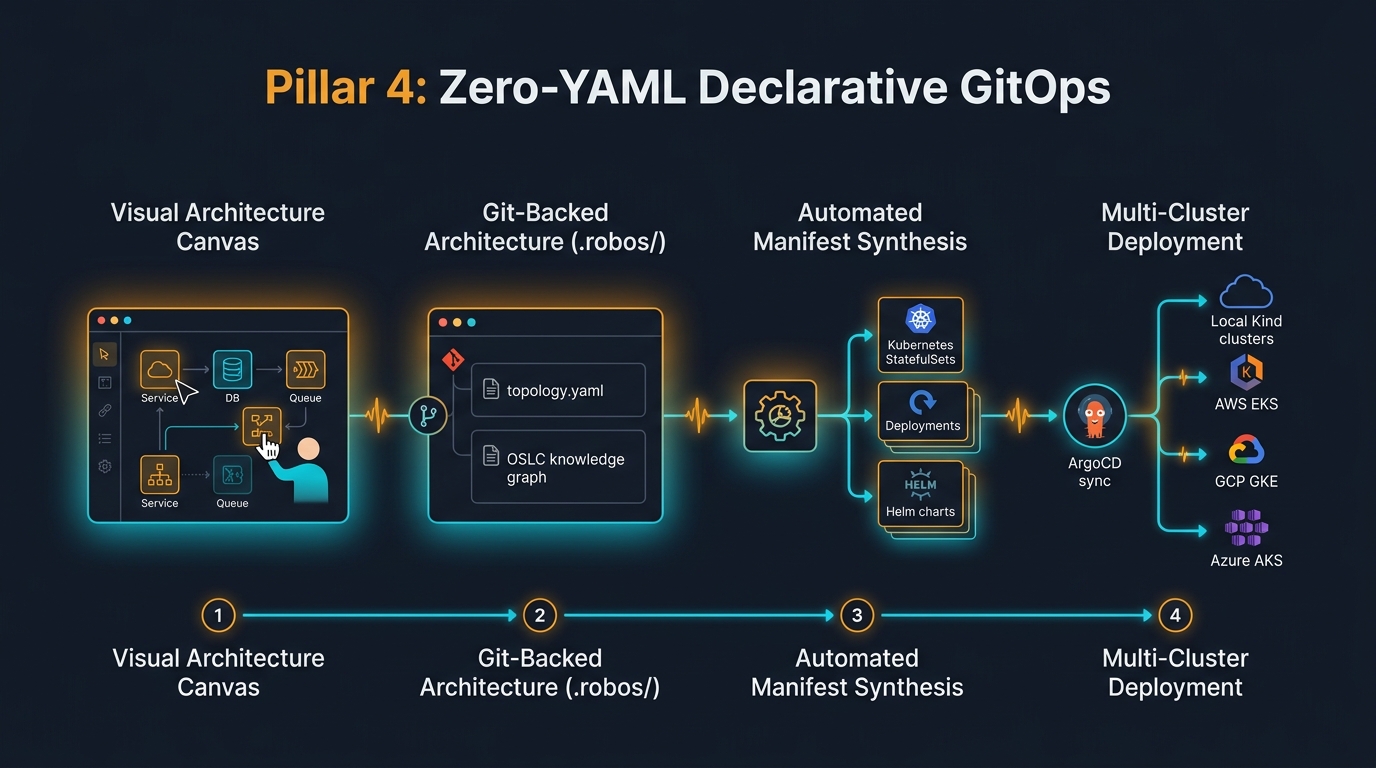
Technical Architecture: From Visual Canvas to Cloud Deployments
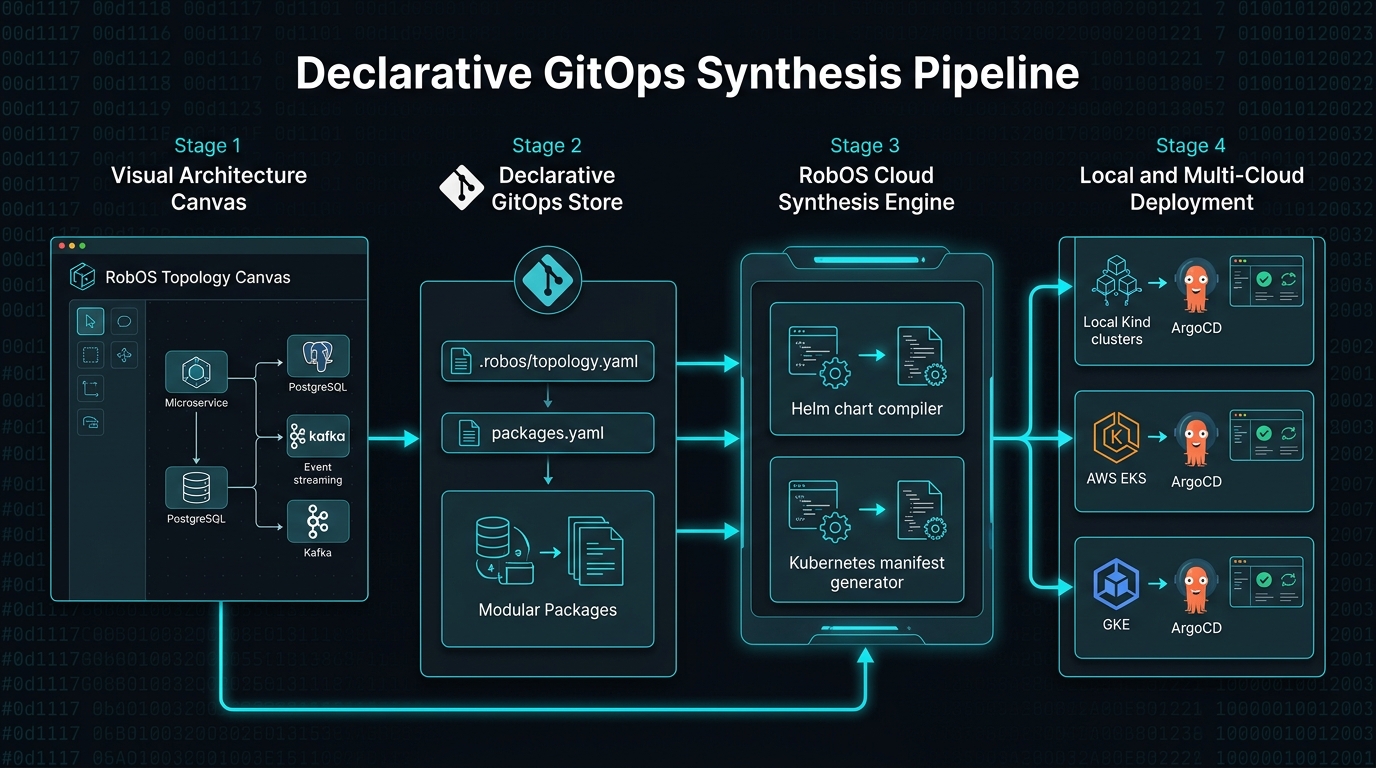
1. Clean Git-Backed Declarations (.robos/)
RobOS stores all architectural declarations in human-readable YAML/JSON-LD files directly inside your Git repository:
.robos/topology.yaml: Container topology, services, databases, exposed ports, and network policies..robos/packages.yaml: Software packages, archetypes, source directories, and build scripts..robos/teams.yaml: Team Topologies, code ownership, and GPG commit signers..robos/kgraphs/: Modular Knowledge Graph packages with formal linked-data semantics.
2. Automated Manifest Synthesis
When you add a node to the visual architecture canvas—such as a PostgreSQL database or a Spring Boot microservice—RobOS automatically generates:
- Kubernetes StatefulSets: Complete with persistent volume claim (PVC) templates, volume mounts, readiness probes, and liveness probes.
- Kubernetes Deployments: Rolling update strategies, resource CPU/memory limits, environment variable bindings, and secret references.
- Kubernetes Services & Ingress: ClusterIP and NodePort bindings, routing annotations, and TLS termination definitions.
- Helm Charts: Standardized Helm structure with
Chart.yaml,values.yaml, and templated resource manifests.
Sample Synthesized Manifest
# Auto-synthesized by RobOS from .robos/topology.yaml
apiVersion: apps/v1
kind: StatefulSet
metadata:
  name: orders-db
  labels:
    app.kubernetes.io/name: orders-db
    robos.dev/managed-by: robos-synthesis
spec:
  serviceName: orders-db-service
  replicas: 1
  selector:
    matchLabels:
      app: orders-db
  template:
    metadata:
      labels:
        app: orders-db
    spec:
      containers:
        - name: postgres
          image: postgres:16-alpine
          ports:
            - containerPort: 5432
          env:
            - name: POSTGRES_DB
              value: orders_production
            - name: POSTGRES_USER
              valueFrom:
                secretKeyRef:
                  name: db-credentials
                  key: username
  volumeClaimTemplates:
    - metadata:
        name: postgres-data
      spec:
        accessModes: ["ReadWriteOnce"]
        resources:
          requests:
            storage: 20Gi
Local to Cloud Continuum: Kind to AWS, GCP & Azure
RobOS seamlessly spans the entire spectrum from single-developer laptops to multi-cloud enterprise deployments:
- Local Kind Kubernetes: RobOS spins up ephemeral or persistent local Kind (Kubernetes in Docker) clusters. Developers test full microservice networks, seeded databases, and mock Prism endpoints on localhost with zero cloud costs.
- Enterprise Multi-Cluster Kube Studio: Connect live to AWS EKS, Google Cloud GKE, or Azure AKS. RobOS Kube Studio (
packages/kube-studio) provides real-time pod log streaming, container exec terminals, and ArgoCD GitOps synchronization to observe live rollouts and deployment health across staging and production.
Next Steps
- Explore RobOS Main Wins: Return to the Main Wins executive overview.
- Unified Data Sources Management: Explore the native relational, NoSQL, and cloud storage management suite.
- Universal Web & API Clients: Learn about Git-backed REST, gRPC, and GraphQL verification tooling.
- Multi-Cluster Kube Studio: Read the application guide for Kube Studio.
- 💡 Explore the Ideas Store on GitHub: View raw idea dumps, community feature proposals, and structured architecture specs.