Universal Web, API & Microservice Client Suite
How RobOS replaces fragmented, cloud-locked API tools by providing a native, Git-backed management GUI and verification client across REST, gRPC, GraphQL, and streaming event protocols directly synchronized with architecture contracts.
Table of contents
- The Strategic Advantage: Ending Protocol Sprawl & Proprietary SaaS Lock-In
- The Multi-Protocol Client Suite
- Contract Verification Gates: Pact & Stoplight Prism
- Next Steps
The Strategic Advantage: Ending Protocol Sprawl & Proprietary SaaS Lock-In
In modern distributed microservice architectures, developers interact with multiple network protocols daily:
- RESTful Web APIs (OpenAPI 3.1) for public web and mobile client endpoints.
- gRPC Services (Protobuf binary RPC) for high-throughput, low-latency inter-service communication.
- GraphQL APIs for flexible, client-driven composite queries.
- Streaming WebSockets & Event Queues (Kafka, RabbitMQ) for asynchronous real-time event updates.
Traditionally, testing and verifying these protocols requires juggling multiple disconnected desktop tools:
- Postman or Insomnia for REST, which increasingly force users into proprietary cloud accounts, sync local data to remote SaaS servers, and charge expensive enterprise seats.
- BloomRPC or Kreya for gRPC, requiring manual file-system loading of
.protofiles. - GraphiQL or Altair for GraphQL.
These disparate tools are completely detached from your Git repository: when an API contract changes, test collections in Postman become obsolete, and autonomous AI agents cannot programmatically run them during verification loops.
The RobOS Big Win:
RobOS provides a native, unified web client and management GUI for REST, gRPC, GraphQL, and streaming protocols—100% Git-backed, open-standard, and continuously synchronized with your API contracts.
Every API request, environment matrix, and test assertion is stored in plain-text Git files directly inside your repository. Furthermore, RobOS automatically synthesizes test collections directly from your OpenAPI contracts and Protobuf definitions, empowering both human engineers and autonomous AI agents to execute automated verification gates with zero vendor lock-in.
The Multi-Protocol Client Suite
RobOS delivers first-class developer applications across every major modern web and network protocol:
1. Git-Backed REST API Client (rest-client)
Powered by the open-source UseBruno (.bru) plain-text format:
- 100% Git-Backed: Requests and assertions are stored in
.brufiles directly in your repository (e.g.,tests/api/orders/create-order.bru). Never synced to third-party cloud servers. - Automated Collection Synthesis: When you author an OpenAPI 3.1 YAML contract, RobOS automatically synthesizes ready-to-run
.brurequest collections complete with query parameters, request bodies, and expected status codes. - Multi-Environment Matrices: Switch between
local,staging, andproductionenvironments with encrypted variables backed by the UNIX password store (pass). - Automated Collection Runner: Run an entire directory of API requests sequentially with assertion scorecards, latency benchmarks, and failure reports.
Sample Git-Backed .bru File
meta {
  name: Create Order
  type: http
  seq: 1
}

post {
  url: /api/v1/orders
  body: json
  auth: bearer
}

headers {
  Content-Type: application/json
  X-Correlation-Id:
}

auth:bearer {
  token:
}

body:json {
  {
    "customerId": "cust_9872",
    "items": [
      { "productId": "prod_101", "quantity": 2 }
    ]
  }
}

assert {
  res.status: eq 201
  res.body.orderId: isDefined
  res.body.status: eq "PENDING"
}
2. RobOS gRPC Client (grpc-client)
A desktop gRPC testing client inspired by BloomRPC and Kreya:
- Dynamic Server Reflection: Point the client to any gRPC server implementing reflection; RobOS automatically discovers all packages, services, RPC methods, and request/response message types without needing manual
.protofile imports. - Streaming Support: Full parity for Unary, Server Streaming, Client Streaming, and Bidirectional Streaming RPCs.
- Custom Metadata & Headers: Configure gRPC metadata headers (JWT authorization, tracing context, deadlines).
3. RobOS GraphQL Client (graphql-client)
A GraphQL IDE inspired by GraphiQL and Altair:
- Interactive Schema Introspection: Explores full GraphQL schemas with interactive type documentation, queries, mutations, and subscriptions.
- Variable Editor: Multi-tab Monaco editor with JSON schema validation for GraphQL variables.
4. Streaming & Event Queue Verification
- Real-time WebSocket connection tester with bi-directional message logging and ping/pong heartbeats.
- Live Apache Kafka topic inspector within the Data Sources Explorer, allowing developers to inspect event payloads, headers, and consumer group offsets.
Contract Verification Gates: Pact & Stoplight Prism
RobOS tightly couples its API clients with Consumer-Driven Contract Testing:
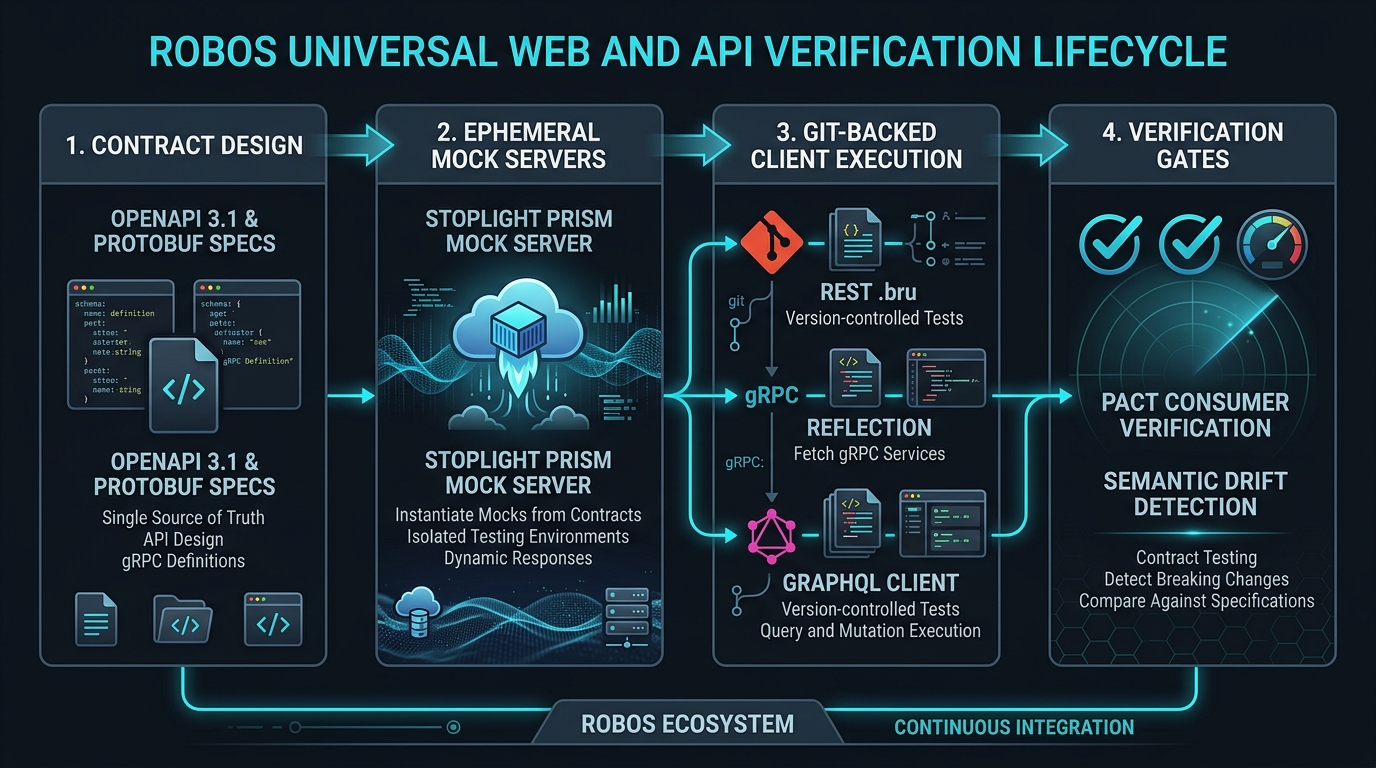
- Stoplight Prism Mock Servers: When designing a new microservice in the Knowledge Graph, RobOS spins up a local Prism mock server. Frontend and client developers can immediately begin issuing real HTTP requests against mock endpoints before backend implementation begins.
- Pact Consumer Contracts: RobOS validates that changes made by AI agents or developers do not break downstream consumers before pull requests can be merged.
Next Steps
- Explore RobOS Main Wins: Return to the Main Wins executive overview.
- Unified Data Sources Management: Connect and explore databases alongside API contracts.
- Interactive Task Planning Studio: Explore interactive task planning templates and structured execution.
- Browse All 30+ Apps: View detailed specifications for the REST API Client, gRPC Client, and GraphQL Client.