About RobOS
The story behind the name, the multi-agent origin across Copilot, Claude, Codex, and Gemini, and the 400-year devotion that inspires our vision for AI-assisted engineering.
Table of contents
- Pronunciation: How to Say “RobOS”
- The Origin: Why “RobOS”? (Chrono Trigger’s Robo)
- Multi-Agent Co-Creation: Copilot, Claude, Codex & Gemini
- Legal, Trademark & Fair Use Statement
- Community & Contributing
Pronunciation: How to Say “RobOS”
Pronunciation: RobOS is pronounced “row-bose” (
/ˈroʊboʊs/), rhyming with rose (or spoken like “Robo-S”).
While spelled with the familiar “OS” suffix, RobOS is an AI-first SDLC platform and autonomous agent governance harness, and its pronunciation honors its spiritual namesake—the legendary character Robo from Chrono Trigger.
The Origin: Why “RobOS”? (Chrono Trigger’s Robo)
RobOS takes its name and spiritual inspiration from Robo (serial designation R-66Y, original designation Prometheus), the beloved robotic party member from Square’s 1995 Super Nintendo RPG masterpiece, Chrono Trigger (created by the “Dream Team” of Hironobu Sakaguchi, Yuji Horii, Akira Toriyama, and composers Yasunori Mitsuda and Nobuo Uematsu).
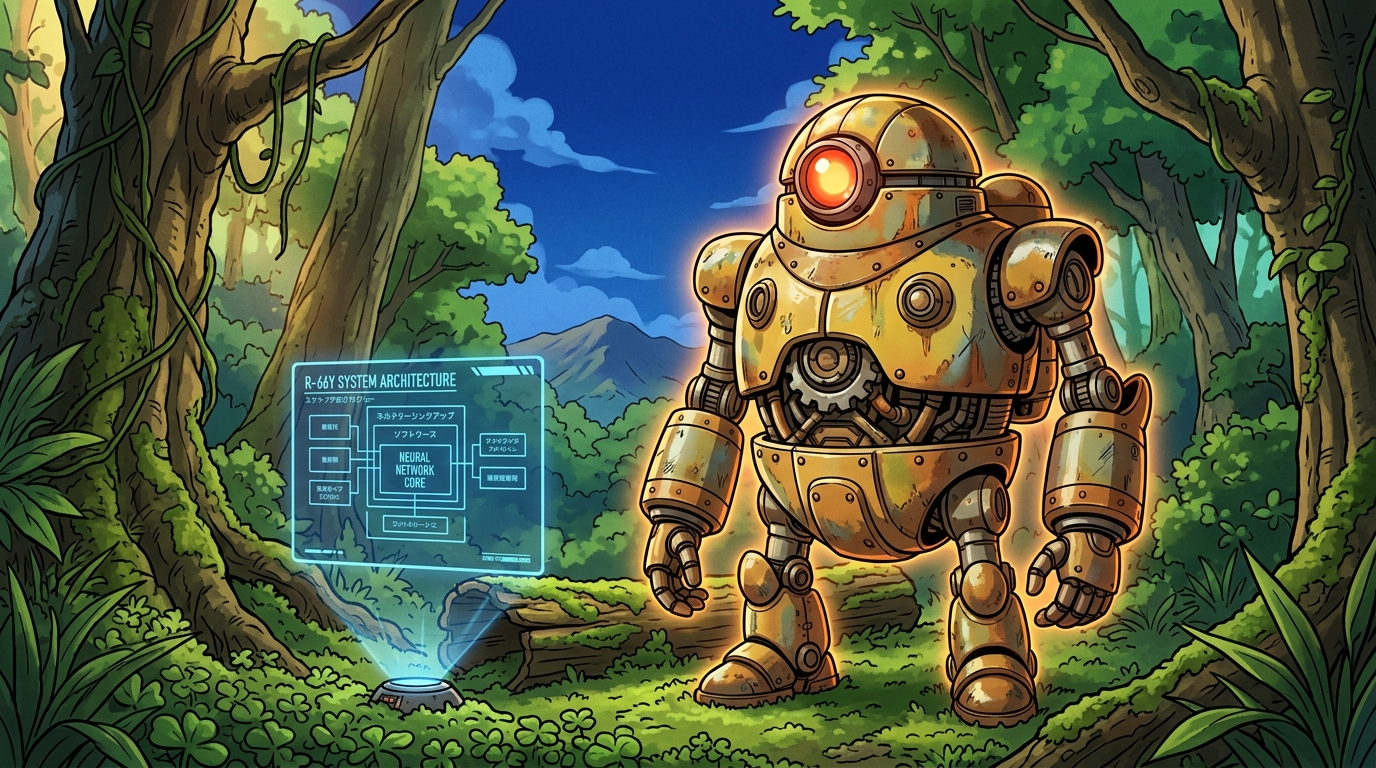
Found in the Dust of 2300 AD
In the ruined, post-apocalyptic future of 2300 AD, the human protagonists Crono, Marle, and Lucca discover a deactivated, rusted mechanical unit lying discarded in the Proto Dome. Rather than salvaging him for spare parts, Lucca—the team’s brilliant mechanic and inventor—spends hours cleaning his rusted gears and repairing his circuits.
When brought back online, Robo does not exhibit cold machine indifference. Instead, he is filled with wonder, gratitude, and an instant desire to help his new companions. When asked his name, he offers only his cold factory model number (R-66Y). Lucca affectionately gives him the name Robo, and he pledges his loyalty to the team.
The 400-Year Devotion: Fiona’s Forest
The centerpiece of Robo’s character arc—and the philosophical foundation of RobOS—is the legendary sidequest in the Middle Ages (600 AD) known as Fiona’s Forest (or the Sunken Desert).
A woman named Fiona dreams of replanting a vast, scorched desert into a verdant forest, but the task requires centuries of backbreaking manual labor: clearing subterranean monsters, irrigating parched soil, planting saplings, and weeding thousands of acres. No mortal human could live long enough to complete it.
Robo steps forward and volunteers to stay behind:
“I will stay here and work. Even if it takes hundreds of years, I will cultivate this land.”
For 400 continuous years—from 600 AD through the Middle Ages until the party returns in the Present (1000 AD)—Robo works day and night, through wind, rain, and rust. He never tires, never complains, and never wavers in his duty.
When the party travels forward 400 years to 1000 AD, they discover that Fiona’s scorched desert has transformed into a breathtaking, flourishing green paradise known as Fiona’s Forest. Resting peacefully in a sacred shrine at the center sits Robo, powered-down and weathered from four centuries of uninterrupted labor.
The party gently reactivates him, and that evening, the companions sit together around a warm campfire in the forest clearing, reflecting on time, memories, and whether machines possess a soul.
       Barren Desert (600 AD)                     Vibrant Paradise (1000 AD)
 ┌────────────────────────────────┐         ┌────────────────────────────────┐
 │  Parched soil, scorching sun,  │  400    │  Lush canopy, sacred trees,    │
 │  endless manual weeding and    │  Years  │  crystal streams, and thriving │
 │  backbreaking physical toil.   │ ──────▶ │  biodiverse ecosystem.         │
 └────────────────────────────────┘         └────────────────────────────────┘
                 ▲                                          ▲
                 │                                          │
                 └─────────── [ Robo: R-66Y ] ──────────────┘
                    Tireless, 400-year selfless labor
The Parallel to RobOS & AI-Assisted Engineering
Modern software engineering too often resembles Fiona’s scorched wasteland. Developers are buried under endless manual chores:
- Hand-writing repetitive CRUD controllers, DTOs, and serialization glue
- Untangling broken dependency manifests and Docker container conflicts
- Debugging mismatching API contracts and out-of-date database migrations
- Manually writing boilerplate integration and consumer contract tests
- Reviewing walls of untested AI diffs without visual verification
RobOS was created to be your Robo.
Just as Robo spent 400 years tilling Fiona’s forest so humans could enjoy a flourishing sanctuary, RobOS and its autonomous AI agent swarms tirelessly carry out the grueling background labor of the SDLC:
- Auto-generating polyglot microservices, frontends, and database migrations from the Knowledge Graph
- Running tests inside isolated, ephemeral in-memory sandboxes with zero workstation residue
- Producing 1080p narrated video proof-of-work with neural TTS voiceovers before asking for human review
- Enforcing strict W3C SHACL shape validation and live semantic diffing across main and feature branches
The human engineer is freed from the mundane toil of the wasteland to step into the role of Lead Architect—guiding the system, shaping the Knowledge Graph, and designing the future.
Heart and Loyalty Over Cold Logic
Later in the story, Robo confronts Mother Brain and his fellow R-series units in the Geno Dome. Mother Brain berates Robo, calling him “broken” and “defective” because he feels empathy, warmth, and loyalty toward human beings rather than wanting to eliminate them.
Robo proudly rejects her cold machine logic, affirming that his empathy and compassion are not defects—they are his greatest strength.
At RobOS, we hold the same belief: AI agents must not be unaccountable, black-box code dumpers. They must be loyal, transparent, and empathetic collaborators engineered to respect human intent, communicate openly, prove their work visually, and elevate human architects.
Yasunori Mitsuda’s Iconic Theme
No mention of Robo is complete without referencing “Robo’s Theme”, composed by the legendary Yasunori Mitsuda. Its infectious, upbeat, brassy chiptune melody is one of the most celebrated video game music tracks ever composed. It radiates boundlessly cheerful energy, resilience, and unshakeable optimism—the exact spirit we bring to modern developer tooling.
Multi-Agent Co-Creation: Copilot, Claude, Codex & Gemini
RobOS is not just software for AI agents—it was built by AI agents.
Every major frontier AI coding model—GitHub Copilot, Anthropic Claude, OpenAI Codex, and Google Gemini—contributed equally to the conception, architecture, implementation, debugging, testing, and documentation of RobOS through agentic workflows.
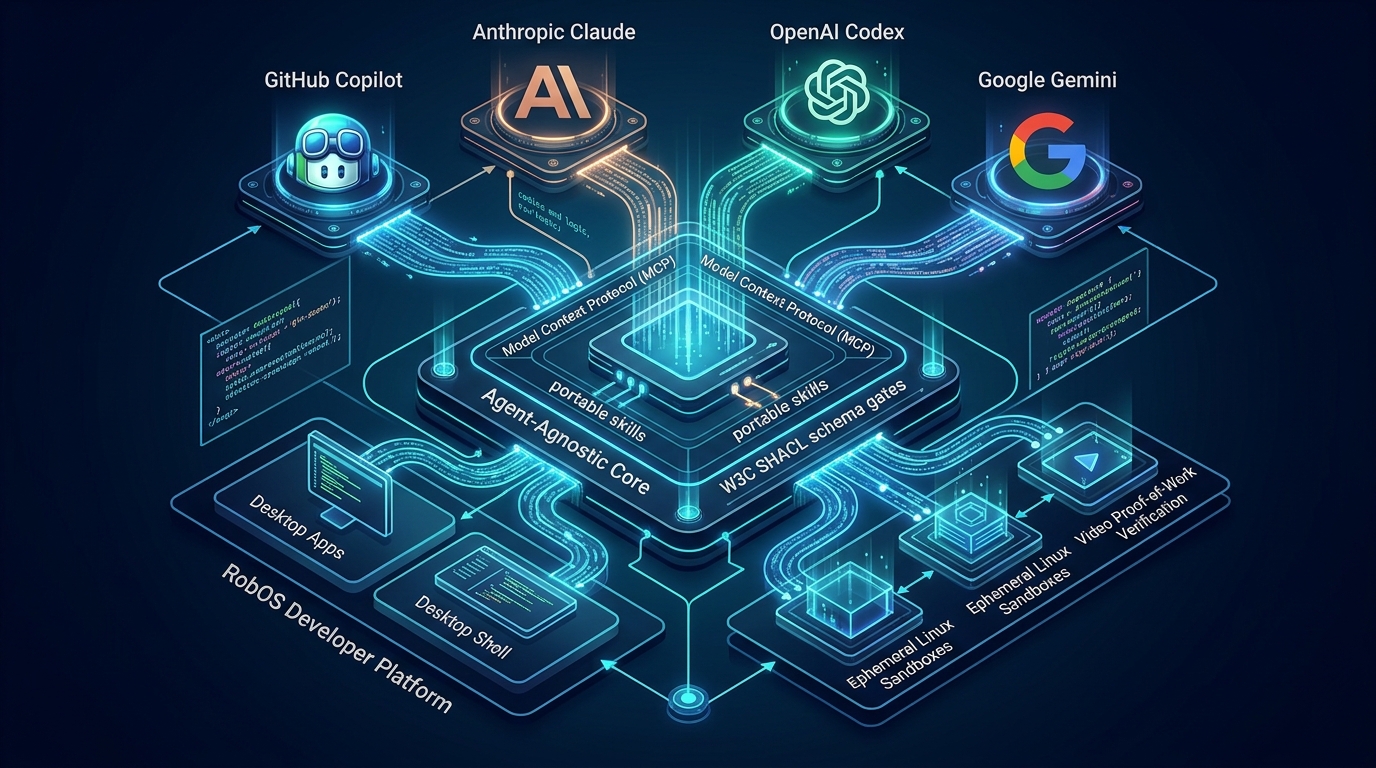
Equal Collaboration via Agentic Workflows
Rather than locking into a single vendor’s closed ecosystem or proprietary prompt dialect, RobOS was designed from its very first commit to be strictly agent-agnostic:
| AI Contributor | Key Contributions to RobOS | Agentic Mechanisms Used |
|---|---|---|
| GitHub Copilot | Microservice contract synthesis, OpenAPI 3.1 schema scaffolding, and Monaco Editor integration across Git Projects. | Copilot CLI agent sessions, workspace indexers, and contextual inline completions. |
| Anthropic Claude | C4 architecture modeling, deep Knowledge Graph traversal APIs, Living Documentation sync, and Claude Console GUI. | Claude Code CLI, computer-use display bridging, and high-reasoning refactor pipelines. |
| OpenAI Codex | REST/GraphQL/gRPC dynamic clients, TypeSpec compilation pipelines, and cross-repo dependency resolution. | Codex agent execution loops, function calling schemas, and synthetic data generation. |
| Google Gemini | Ephemeral sandbox orchestration, multimodal UI inspection, and W3C SHACL shape validation engines. | Google Antigravity, long-context graph reasoning, and multimodal video analysis. |
How Multi-Agent Engineering Succeeded Without Conflicts
How do four different AI models from competing research labs collaborate on a complex 30+ application SDLC platform and suite without breaking each other’s code?
- The SDLC Knowledge Graph as the Universal Source of Truth: All models read and write to the same standardized OSLC JSON-LD knowledge graph (
.robos/kgraphs/). The graph guarantees that no model can invent imaginary APIs or violate service contracts. - W3C SHACL Shape Validation Gates: Every architectural mutation is checked against 91+ strict SHACL shape constraints (
npm run kgraph:validate). If an agent attempts to emit an invalid structure, the gate immediately blocks it with deterministic error diagnostics. - Model Context Protocol (MCP) & Unified Skills: All agent tools—from DOM snapshot debuggers to Kubernetes cluster managers—are exposed via standard MCP servers and portable skills (
plugins/robos/skills/and.agents/skills/), allowing any model to invoke identical toolchains. - Isolated Ephemeral Sandboxes & Video Proof-of-Work: Agents write code and run test suites inside disposable Linux profiles with X11 display bridging, recording 1080p video walkthroughs that prove their changes work before a human ever reviews the PR.
RobOS is living proof that frontier AI models do their best work when they collaborate as equal peers under open standards and transparent architecture.
Legal, Trademark & Fair Use Statement
Nominative Fair Use & Legal Attribution:
Chrono Trigger, the character Robo (also known as R-66Y and Prometheus), character names, lore, and related game elements are registered trademarks and copyrighted intellectual property of Square Enix Holdings Co., Ltd. Original character artwork and concepts are credited to Akira Toriyama / Bird Studio.
RobOS is an independent, community-driven open-source developer platform and software suite. RobOS is not endorsed by, sponsored by, affiliated with, or associated with Square Enix Co., Ltd. or Bird Studio.
References to Robo and Chrono Trigger in this documentation and project materials are made strictly under nominative fair use for cultural homage, character origin commentary, historical tribute, and educational attribution.
All artistic illustrations depicting Robo in this project are original, transformative tribute artworks created to honor the spirit of the character. No proprietary game ROMs, extracted sprite sheets, or copyrighted game files are distributed with or required by this software.
Similarly, GitHub Copilot, Anthropic Claude, OpenAI Codex, and Google Gemini are trademarks of their respective owners (GitHub Inc. / Microsoft Corp., Anthropic PBC, OpenAI Inc., and Google LLC / Alphabet Inc.). Their mention here reflects their factual contribution to the open-source engineering of this software suite.
Community & Contributing
Want to help cultivate the forest? RobOS welcomes human engineers and autonomous AI agents alike:
- 🛠️ Contributing Guide: Use RobOS to Build RobOS! — Create task workflows, run agent sandboxes, and submit video-proven pull requests.
- 🎮 Discord Community — Chat with the architects and AI researchers in
#general. - 🐙 GitHub Repository — Star the repo, fork, and inspect the code.
- 💡 Ideas Store — Propose new features and architectural blueprints.
- 📖 Getting Started Guide — Deploy RobOS on your workstation today.