Agent-Agnostic Open Framework & Algorithmic Independence
How RobOS decouples developer platform capabilities and SDLC architecture from proprietary AI models—using open global standards to eliminate vendor lock-in and assign the right agent to the right task for optimal value and cost.
Table of contents
- The Strategic Advantage: Breaking Free from Vendor Lock-In
- The Open Standards Foundation
- Right Agent for the Right Task: Value & Cost Optimization
- Universal Cross-Agent Skill Marketplace
- Sovereign & Air-Gapped Local Model Execution
- Next Steps
The Strategic Advantage: Breaking Free from Vendor Lock-In
The rapid acceleration of generative AI has created a severe risk for engineering organizations: proprietary vendor capture.
When an engineering team builds its workflows around a single closed ecosystem:
- Proprietary Prompt & Rule Lock-In: Instructions and skills are formatted for one specific tool’s proprietary syntax. Migrating to another model requires rewriting thousands of lines of prompts.
- Algorithmic Obsolescence: The AI model leader changes every 6 months. Teams bound to a single vendor cannot easily swap to a superior, faster, or cheaper reasoning model.
- Overpaying for Low-Complexity Tasks: High-tier frontier reasoning models ($15–$60 per million tokens) are wastefully invoked for trivial tasks like lint fixing, unit test boilerplates, and schema formatting.
- Data Sovereignty & Privacy Barriers: Regulated industries (healthcare, finance, defense) cannot use external commercial APIs and need strict, offline, air-gapped local model execution.
The RobOS Big Win: Algorithmic Independence
RobOS is completely agent-, model-, and algorithm-agnostic. By building upon open global standards implemented out in the open, RobOS separates developer workstation context, SDLC architecture, and task orchestration from the underlying intelligence engine.
Engineering teams maintain complete sovereignty: swap underlying models at will, dispatch the right agent to the right task based on complexity and cost, and run fully offline when necessary.

The Open Standards Foundation
Instead of inventing proprietary formats, RobOS anchors every layer of the Software Delivery Lifecycle to battle-tested global open standards developed by international standards bodies (OASIS, W3C, Linux Foundation):
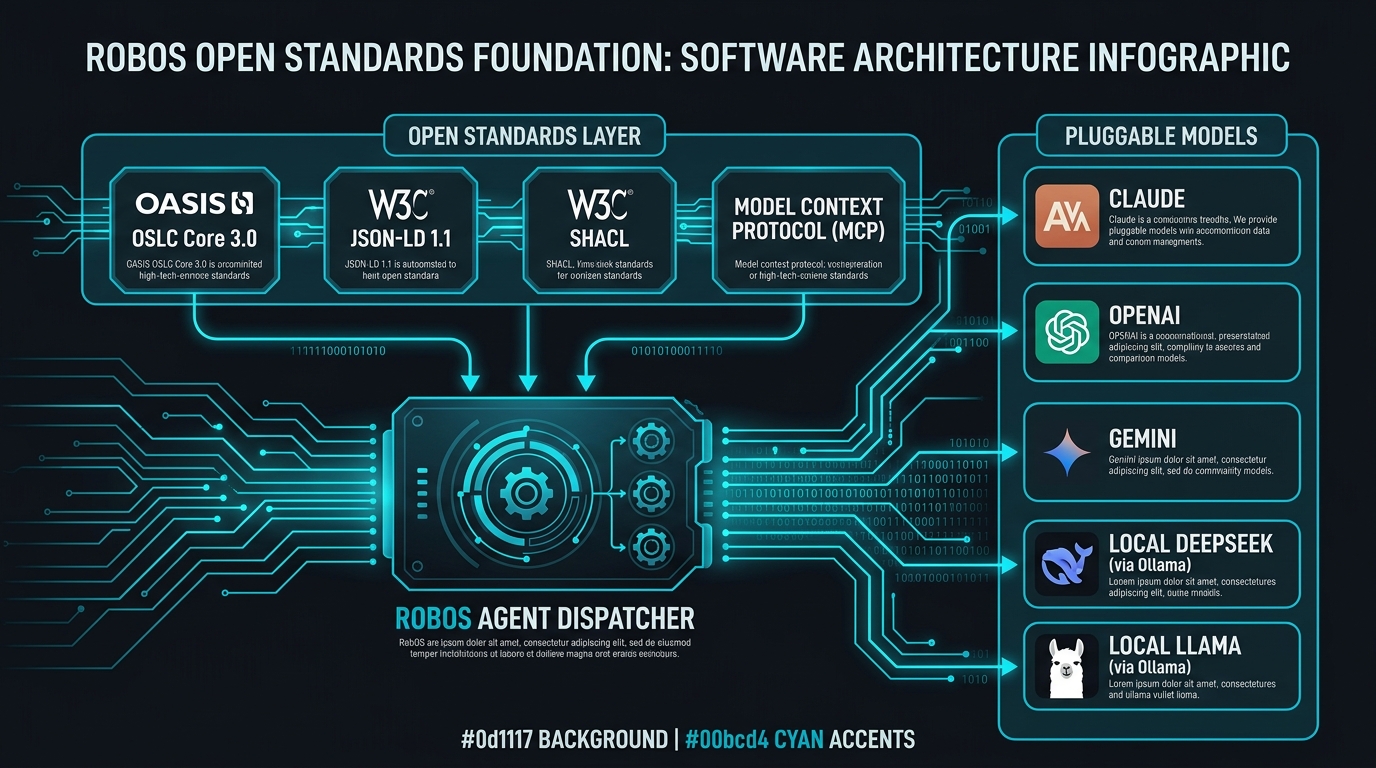
1. OASIS Open Services for Lifecycle Collaboration (OSLC)
RobOS structures software lifecycle objects using OASIS OSLC Core 3.0:
oslc_rm:Requirement: Business requirements and functional specifications linked to Gherkin BDD scenarios.oslc_cm:ChangeRequest: Epics, user stories, and GitHub/Jira task servers.oslc_am:Resource: Architecture components, microservices, databases, and client apps.oslc_qm:TestPlan: Verification suites, automated E2E tests, and contract verification checks.
Because OSLC is an open standard, your project knowledge is not trapped in a proprietary AI vendor’s database.
2. W3C JSON-LD 1.1 & W3C SHACL
System topology lives in human-readable JSON-LD directly within your Git repository (.robos/kgraphs/). Constraints are validated with W3C SHACL (Shapes Constraint Language), guaranteeing that any agent, regardless of vendor, adheres to strict structural integrity rules.
3. Model Context Protocol (MCP)
RobOS implements Anthropic’s open Model Context Protocol (MCP) across all desktop applications, task managers, and developer tools. Any MCP-compliant client or agent can discover and invoke RobOS tools without custom integrations.
Right Agent for the Right Task: Value & Cost Optimization
Not every programming task requires a massive frontier reasoning model. Invoking an expensive model to fix a syntax typo or reformat YAML wastes engineering budget.
RobOS incorporates a Task-to-Value Dispatch Matrix, routing tasks to the optimal intelligence tier:
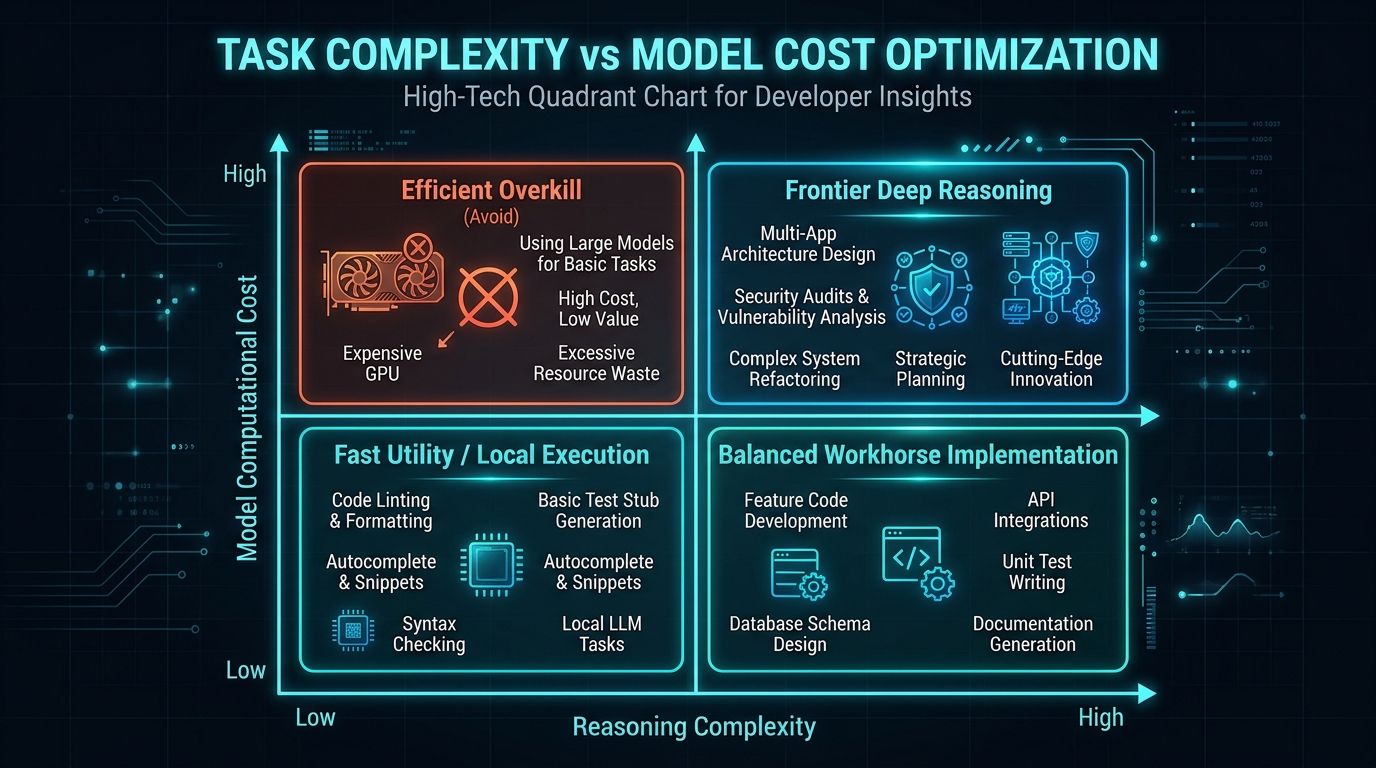
The 3 Agent Tiers in RobOS
| Tier | Typical Models | Optimal SDLC Tasks | Cost Profile |
|---|---|---|---|
| Tier 1: Fast Utility & Local | Gemini 2.5 Flash, Claude Haiku 4.5, Local Ollama (Llama, DeepSeek) | Commit message generation, lint fixing, schema validation, test stub boilerplate, and offline air-gapped tasks. | Ultra-low cost (<$0.10/M tokens) or $0 (Local GPU). |
| Tier 2: Workhorse Implementation | Claude Sonnet 5, GPT-5, Gemini 2.5 Pro | Feature implementation, REST/gRPC API controllers, database migrations, and component unit tests. | Balanced efficiency ($3–$15/M tokens). |
| Tier 3: Frontier Deep Reasoning | Claude Opus 5 / Thinking, OpenAI o3, DeepSeek R1 | Multi-app architectural synthesis, cross-microservice refactoring, distributed consensus tracing, and security audits. | Premium high-reasoning tier ($15–$60/M tokens). |
📘 Looking for the deep dive? Read the comprehensive guide: Agent Tiers, Model Dispatch & Prompt Optimization (Caveman & DSPy) for detailed tier breakdowns, token reduction algorithms, and Settings Console configuration.
Universal Cross-Agent Skill Marketplace
All RobOS skills and automation plugins under plugins/robos/skills/ and .agents/skills/ are designed with universal compatibility:
- Works Across All Major Agent Tools: Compatible with Claude Code, OpenAI Codex, Google Antigravity, GitHub Copilot CLI, Gemini CLI, Cursor, and Windsurf.
- Consistent Tool Declarations: Skills declare standard
SKILL.mdfrontmatter, parameter schemas, and shell execution scripts. - Decoupled Business Logic: Skill logic executes through standard Linux shell commands, Node.js scripts, and CLI binaries inside the RobOS desktop environment.
Example: Invoking Skills from Any Agent
# In Claude Code:
claude "Run e2e-driven-dev skill on billing-service"

# In Google Antigravity / Gemini CLI:
agy "Deploy latest kgraph changes using sync-kgraph-docs skill"

# In GitHub Copilot CLI:
copilot-cli exec "Run create-feature-spec for OpenSearch studio"
No matter which AI assistant your organization prefers today—or adopts tomorrow—your skills, workflows, and Knowledge Graph blueprints remain 100% operational.
Sovereign & Air-Gapped Local Model Execution
For enterprises with strict data sovereignty, GDPR, HIPAA, or defense compliance requirements, RobOS provides 100% on-premise execution:
- Local LLM Backends: Seamless connection to local Ollama, vLLM, or llama.cpp servers running on workstation GPUs or private corporate clusters.
- Zero External Telemetry: In Sovereign Mode, RobOS disables all external network calls; Knowledge Graph parsing, SHACL validation, and agent reasoning execute entirely within the local QEMU/KVM virtual machine.
- Local Video Proof & Speech: Screen recording (FFmpeg) and audio narration (Piper TTS) run completely offline without cloud speech APIs.
Next Steps
- Explore RobOS Main Wins: Return to the Main Wins executive overview.
- Ephemeral In-Memory Sandboxes: Learn how agents execute safely in RAM with zero machine clutter.
- Universal Web & API Clients: Explore Git-backed REST, gRPC, and GraphQL client tools.
- RobOS Skills Catalog: Review the open catalog of cross-agent developer skills.
- 💡 Explore the Ideas Store on GitHub: View raw idea dumps, feature proposals, and community specifications.