Dual-State SDLC Knowledge Graph & Automated Blast Radius
How RobOS maintains simultaneous models of production reality and proposed feature branches, calculating the exact blast radius of every change across microservices, schemas, and contracts before coding begins.
Table of contents
- The Strategic Advantage: Seeing the System Beyond the File
- The Dual-State Model: World 1 vs. World 2
- Automated Pre-Code Blast Radius Calculation
- Hierarchical Agent Context & Multi-Level Rules Inheritance (Eliminating Duplicate Skills)
- Living Documentation Continuous Synchronization
- Standards-Based Foundation: OASIS OSLC & W3C JSON-LD
- Next Steps
The Strategic Advantage: Seeing the System Beyond the File
Traditional developer environments suffer from severe myopia: an editor only understands plain text files within a single working folder. When an engineer or autonomous coding assistant modifies a database column or alters an API payload:
- It has no awareness that a downstream mobile app will crash upon receiving the updated response.
- It doesn’t know that an analytics data pipeline depends on the renamed column.
- It cannot determine which consumer contracts or documentation pages are broken until runtime defects occur in production.
RobOS solves this through the Dual-State SDLC Knowledge Graph:
Instead of treating codebases as isolated silos, RobOS maintains an executable, connected architecture graph linking systems, services, data entities, contracts, teams, tasks, and documentation. Powered by international open standards—OASIS OSLC Core 3.0, W3C JSON-LD 1.1, and W3C SHACL—the Knowledge Graph models not just what code exists today, but how the entire ecosystem changes tomorrow.
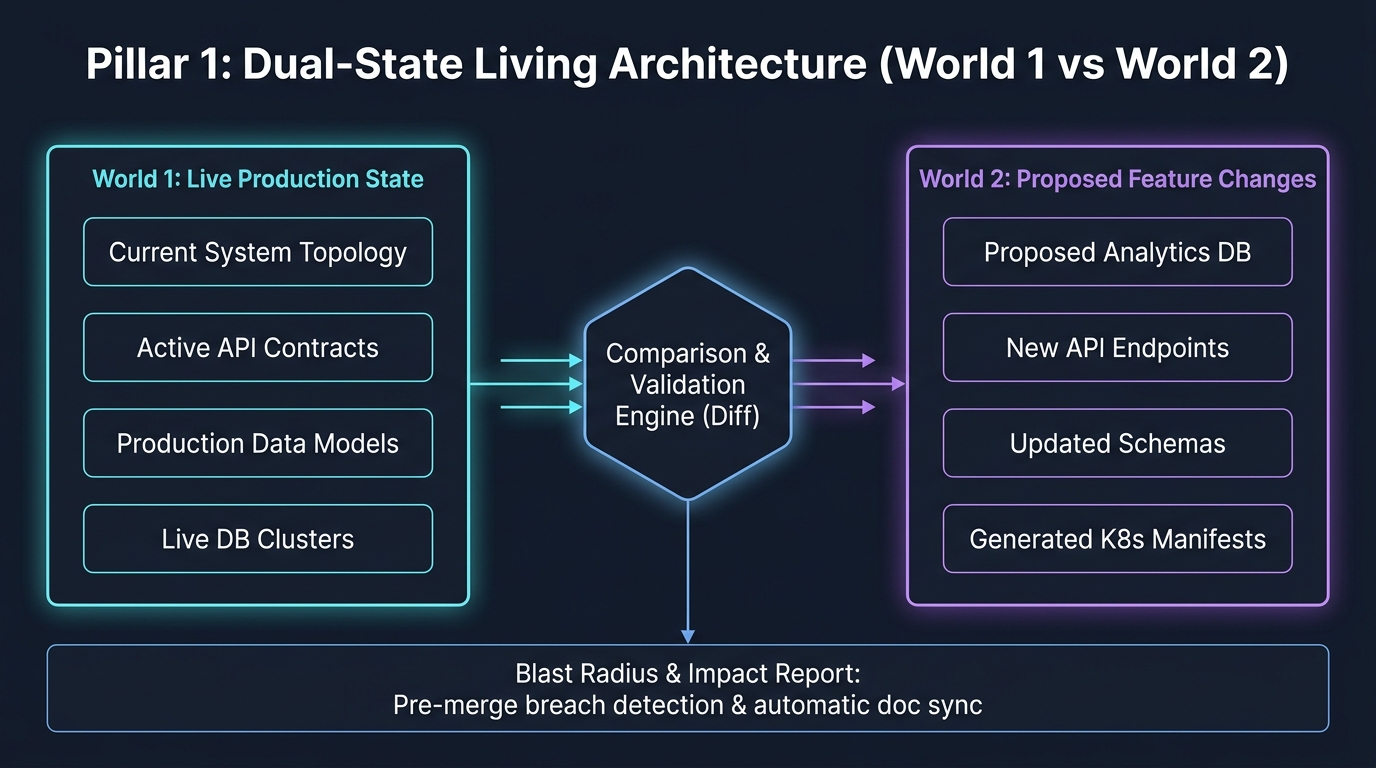
The Dual-State Model: World 1 vs. World 2
RobOS leverages Git branching to maintain two simultaneous representations of architectural reality:
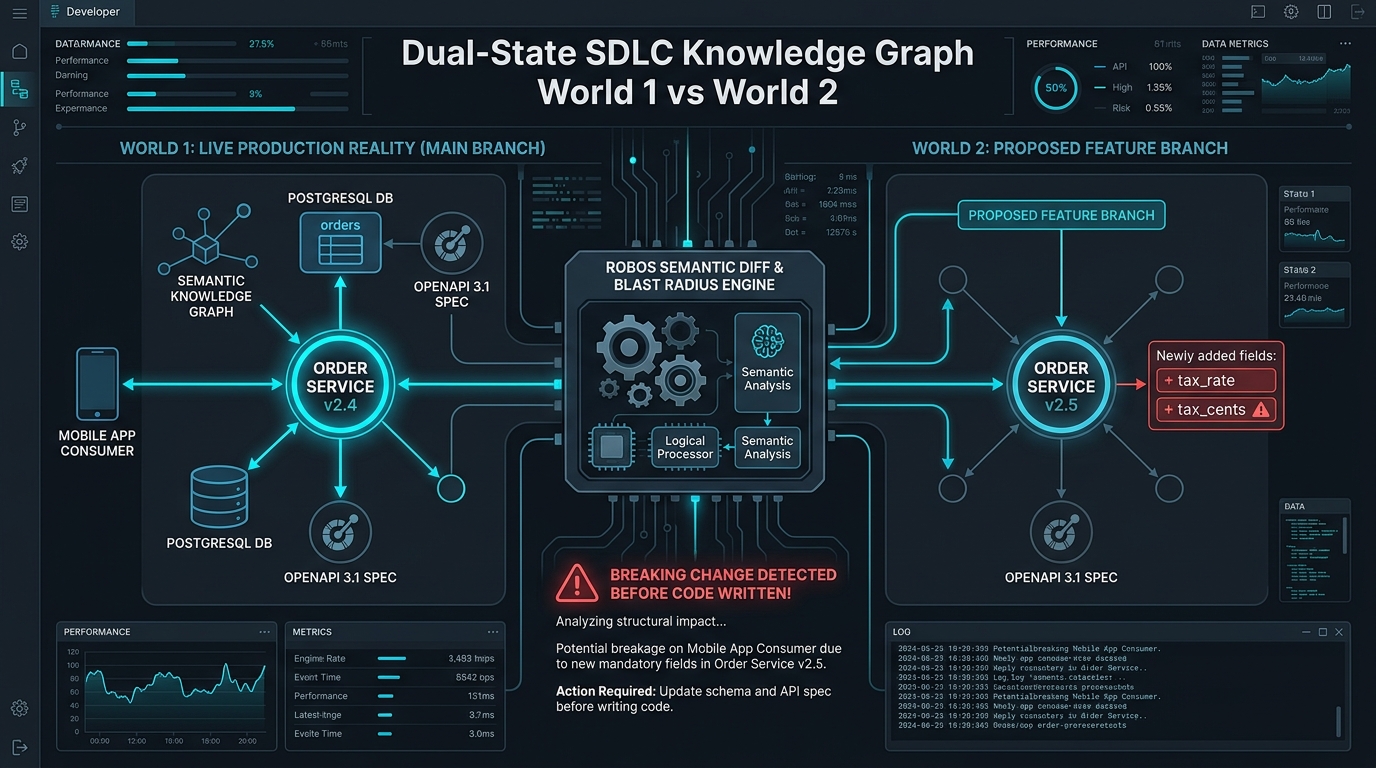
World 1: Production Reality (main)
World 1 represents what is actively running in production:
- Deployed microservice versions and container configurations
- Live database schemas, indices, and connection strings
- Active consumer contracts and verified Pact agreements
- Team ownership boundaries and on-call rotations
World 2: Proposed Feature Branch (feature/*)
World 2 represents the proposed state of the universe once a pull request, spike, or architectural change is merged:
- Altered TypeSpec domain schemas
- Updated OpenAPI endpoints or gRPC Protobuf definitions
- New database tables or added columns
- Newly registered microservices, frontends, or background pipelines
Automated Pre-Code Blast Radius Calculation
Before an autonomous agent or human engineer writes a single line of application code, RobOS executes Semantic Graph Diffing:
- Entity Drift Detection: RobOS compares the JSON-LD triples between the active branch and the
mainbranch. - Dependency Edge Traversal: The engine traverses dependency edges (
robos:consumesAPI,robos:dependsOnService,robos:persistsTo,robos:tracksRequirement). - Consumer Contract Verification: If an endpoint schema change violates an existing consumer contract (e.g. removing a required JSON field or changing a type from
integertostring), RobOS immediately flags a Breaking Contract Violation. - Impact Visualization in Dev Central: The lead architect sees a color-coded blast radius map:
- 🔴 High Risk: Broken downstream consumer contracts requiring coordination.
- 🟡 Medium Risk: Database schema alterations requiring migration scripts.
- 🟢 Low Risk: Additive non-breaking endpoints or documentation updates.
{
  "@type": "robos:BlastRadiusReport",
  "sourceChange": "urn:robos:contract:orders-api#OrderCreateRequest",
  "changeType": "BreakingFieldTypeChanged",
  "field": "tax_cents",
  "impactedConsumers": [
    {
      "appId": "mobile-checkout-ios",
      "team": "checkout-squad",
      "consumerContract": "urn:pact:orders-mobile-contract-v4"
    }
  ],
  "remediation": "Generate backward-compatible API adapter or bump major API version to /v2/orders."
}
Hierarchical Agent Context & Multi-Level Rules Inheritance (Eliminating Duplicate Skills)
In traditional AI coding setups, software engineering organizations face an unsustainable maintenance bottleneck: prompt rule and skill duplication across repositories.
When developers rely on file-local configurations (.cursorrules, CLAUDE.md, .github/copilot-instructions.md, or custom skill manifests):
- Excessive Duplication: Security guidelines, license requirements, commit formatting rules, and testing standards are copy-pasted across dozens or hundreds of individual repositories.
- Rule Drift & Stale Agents: When a company-wide policy changes (e.g. banning a compromised dependency, enforcing GPG-signed commits, or updating an API authentication standard), dozens of repositories remain outdated.
- Context Blindness: An autonomous agent operating in a microservice has no awareness of the parent organization’s open-source bylaws, foundation rules (e.g., Apache Software Foundation policies), or team-level ownership protocols.
The Big Win: Graph-Inherited Agent Context
RobOS leverages the Knowledge Graph hierarchy to define agent context, skills, and rules once at the appropriate level, dynamically synthesizing the effective context whenever an agent session starts:
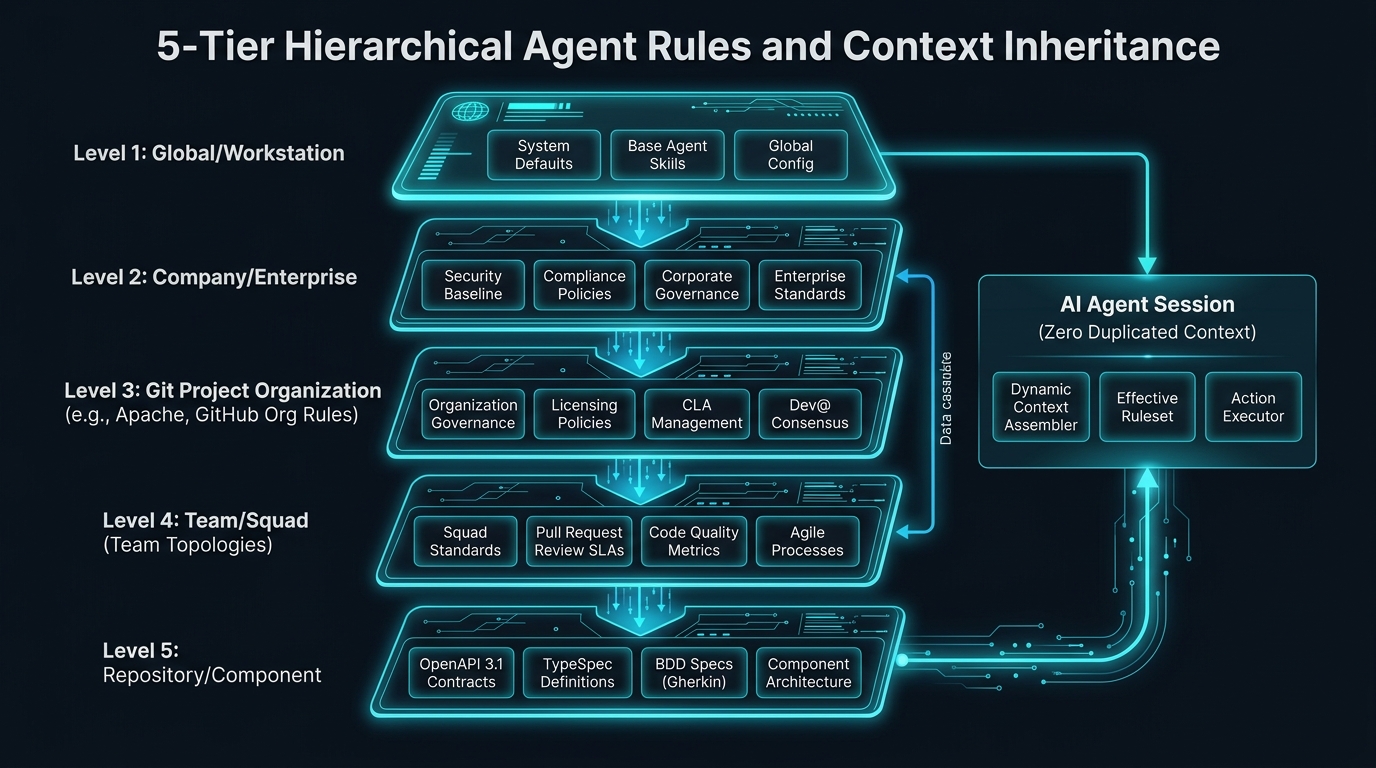
The 5 Hierarchical Context Levels
| Level | Knowledge Graph Store | Scope & Injected Capabilities | Duplicate Maintenance Eliminated |
|---|---|---|---|
| 1. Global / System | robos.core / RobOS Preferences | System-wide developer defaults, base agent skills (add-ai-text-area-to-app, app-snapshot, etc.), global shell environments, and standard SDLC conventions. | Eliminates re-declaring base skills and toolchains across individual developer workstations. |
| 2. Company / Enterprise | robos:Company / Enterprise Sync | Corporate security baseline, allowed dependencies/registries, SSO SCIM policies, and enterprise-wide architectural review mandates. | Eliminates copying corporate compliance policies into 100+ separate service repositories. |
| 3. Git Project Organization | robos:GitProjectOrganization (robos.org) | Forge-level governance (e.g. https://github.com/apache), org-wide documentation hubs (docsUrl), open-source licenses (license), and org agent rules (robos:agentRules e.g. ASF license headers, public dev@ consensus tracing). | Prevents copy-pasting foundation or forge guidelines across 350+ member repos (Kafka, Spark, Lucene). |
| 4. Team / Squad | robos:Team (robos.org) | Team Topologies (stream-aligned, platform), code ownership boundaries, team lead approvers, and on-call escalation procedures. | Configured once in the team topology node; all squad repositories inherit ownership context. |
| 5. Repository / Component | robos:Microservice, robos:FrontEndApp | Service-specific OpenAPI 3.1 contracts, Protobuf stubs, TypeSpec models, and Gherkin .feature acceptance criteria. | Individual repositories focus solely on their distinct business logic and contract models. |
Dynamic Downward Traversal in Action
When an autonomous agent investigates a bug or opens a pull request on https://github.com/apache/kafka:
- Forge Organization Rules Injected: RobOS traverses to
urn:robos:git-org:apache, injectingRULE-APACHE-001(ASF license header verification) andRULE-APACHE-002(dev@ consensus citation). - Enterprise & Team Policies Merged: Corporate security rules (secret leak prevention) and team approver rosters are automatically merged into the session prompt.
- Local Component Contracts Linked: The microservice’s local OpenAPI contracts and TypeSpec schemas provide exact AST-level context.
- Zero Skill Duplication: The repository maintains zero redundant prompt files or duplicated skill definitions. Updating a rule at the organization level in the Knowledge Graph takes effect instantly across all 350+ repositories.
Living Documentation Continuous Synchronization
A major disease of enterprise software is Documentation Rot—system architecture diagrams, READMEs, and wiki pages drift out of date within weeks of being written.
In RobOS, the Knowledge Graph is the living heartbeat of system documentation:
┌────────────────────────────────────────────────────────┐
│ 1. Ingest Knowledge Graph Deltas                       │
│    Inspect added/modified nodes in Modular KGraph Pkgs │
└──────────────────────────┬─────────────────────────────┘
                           │
┌──────────────────────────▼─────────────────────────────┐
│ 2. Discern Noticeable Documentation Impacts            │
│    Identify impacted docs: README.md, docs/index.md,   │
│    docs/project-plan/, specs, and .robos/ GitOps files │
└──────────────────────────┬─────────────────────────────┘
                           │
┌──────────────────────────▼─────────────────────────────┐
│ 3. Apply Synchronized Documentation Updates            │
│    Update markdown files, tables, and architecture     │
│    diagrams to reflect latest graph entities           │
└────────────────────────────────────────────────────────┘
The RobOS Cardinal Rule for AI Agents: Whenever Knowledge Graph objects are updated (added, altered, or deleted), the AI is prompted to discern any noticeable updates needed across system documentation (docs/index.md, README.md, docs/project-plan/, API specs) and update them automatically.
Standards-Based Foundation: OASIS OSLC & W3C JSON-LD
RobOS builds upon established, battle-tested open standards rather than proprietary formats:
- OASIS OSLC Core 3.0: Standardizes requirements management (
oslc_rm:Requirement), change management (oslc_cm:ChangeRequest), architecture management (oslc_am:Resource), and quality management (oslc_qm:TestPlan). - W3C JSON-LD 1.1: Human-readable JSON format with semantic linked-data semantics, allowing graphs to be stored directly in Git repositories under
.robos/kgraphs/. - W3C SHACL (Shapes Constraint Language): Enforces schema correctness before graphs are committed, preventing malformed nodes, missing fields, or invalid enum values.
Next Steps
- Explore RobOS Main Wins: Return to the Main Wins executive overview.
- Ephemeral In-Memory Sandboxes: Learn how agents execute safely in RAM with zero machine clutter.
- Video Proof-of-Work: Understand automated headless screen recordings and neural voiceovers.
- Dedicated Knowledge Graph Guide: Read the full technical specification for RobOS Knowledge Graph packages and schemas.
- 💡 Explore the Ideas Store on GitHub: View raw idea dumps, community feature proposals, and structured architecture specs.