Unified Data Source Client & Management Suite
How RobOS eliminates heavy third-party database tools by providing a native, unified client and management GUI across Relational (PostgreSQL, MySQL, Oracle), NoSQL (MongoDB, Redis), Search, and Cloud Object Stores directly connected to the Knowledge Graph.
Table of contents
- The Strategic Advantage: Ending Data Tool Fragmentation & Context Switching
- The Unified Data Management Suite
- Architectural Grounding: Bridging Data to the Knowledge Graph
- Next Steps
The Strategic Advantage: Ending Data Tool Fragmentation & Context Switching
In traditional development workflows, engineers manage their data layer across a fragmented sprawl of heavy, memory-hungry, and disconnected third-party tools:
- DBeaver or DataGrip for PostgreSQL, MySQL, or Oracle relational databases.
- MongoDB Compass for document collections.
- RedisInsight for in-memory caches and key-value queues.
- AWS S3 Browser or Cloud Console for object vaults.
- Kibana or OpenSearch Dashboards for search and log indices.
Each tool consumes gigabytes of workstation memory, requires independent connection configurations, operates in total isolation from your codebase, and has zero awareness of your architectural contracts. When an engineer or autonomous AI agent writes a feature, they must manually juggle credentials, open external applications, and visually cross-reference table schemas.
The RobOS Big Win:
RobOS provides a native, unified data source client and management GUI across Relational, NoSQL, Search, and Cloud Storage—deeply integrated into the OS desktop and continuously synchronized with the Knowledge Graph.
Developers inspect live schemas, run sub-millisecond SQL queries, edit MongoDB documents, modify Redis key TTLs, and browse S3 contract vaults within a unified, dark-themed native suite. Furthermore, database schemas are automatically introspected to populate KGraph entity models and TypeSpec definitions without manual data entry.
The Unified Data Management Suite
RobOS integrates three core native applications designed to cover every persistence paradigm:
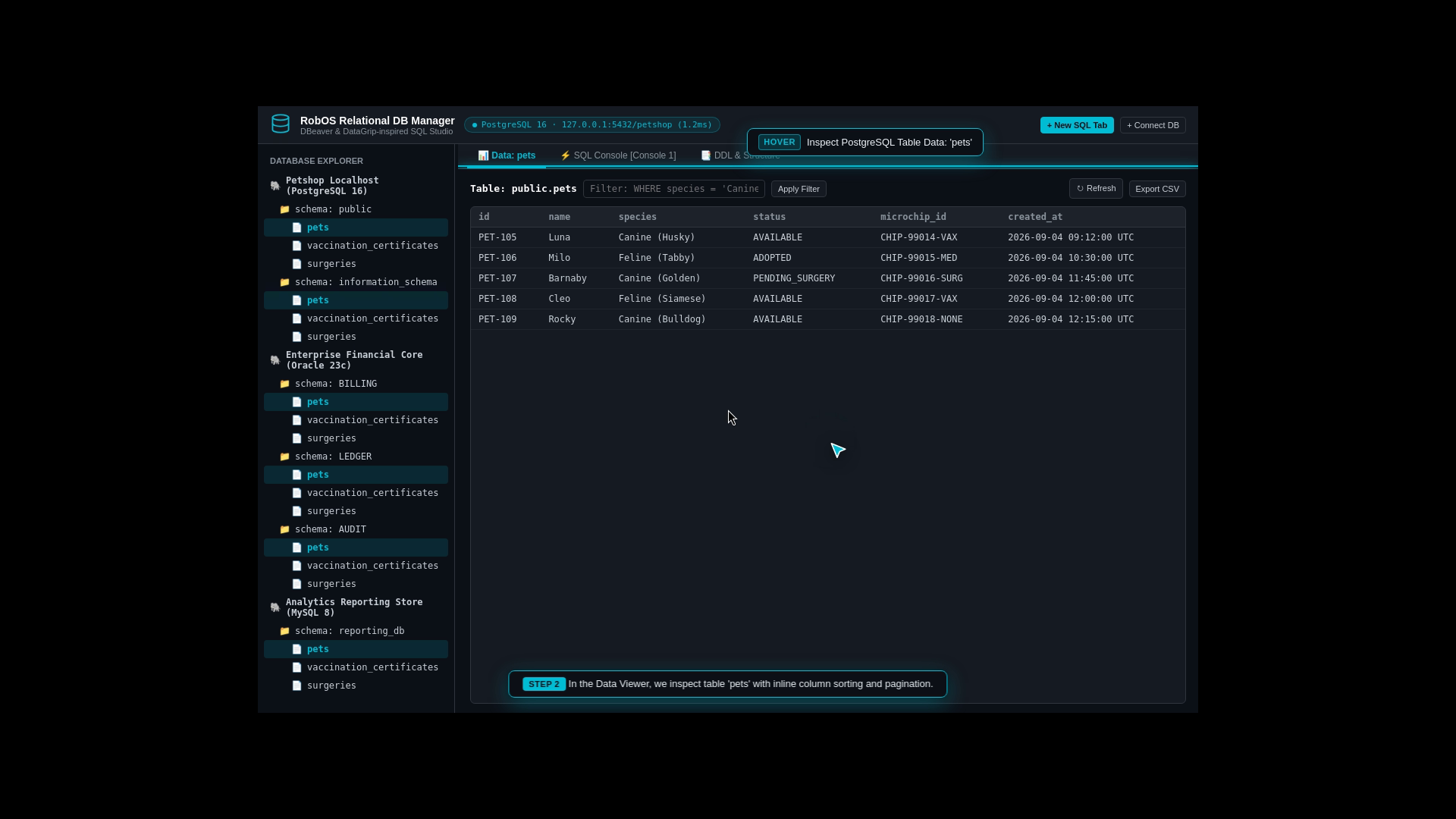
1. RobOS Relational DB Manager (relational-db-manager)
A professional SQL development environment inspired by DBeaver and DataGrip, supporting PostgreSQL, MySQL, and Oracle:
- Multi-Tab SQL Console: Monaco editor with SQL syntax highlighting, keyword auto-completion, formatters, and query history.
- Sub-Millisecond Execution Telemetry: Live performance scorecards reporting execution duration (ms), rows fetched, and memory footprint.
- Interactive Data Grid: Inline cell editing, sortable columns, multi-column filters, and pagination controls.
- Schema Explorer: Tree view of schemas, tables, columns, data types, primary keys, foreign key constraints, and indices.
- Instant DDL Generator: 1-click generation of
CREATE TABLEstatements, foreign key relationships, and Flyway/Liquibase migration stubs.
2. RobOS NoSQL DB Manager (nosql-db-manager)
A dedicated document and key-value management client inspired by MongoDB Compass and RedisInsight:
- MongoDB Document Explorer: Search collections via JSON queries (
{ status: "active", age: { $gte: 21 } }), edit BSON documents in an inline JSON editor, and inspect collection indexes. - Redis Key-Value Inspector: Browse keys by pattern (
session:*,cache:*), inspect data types (Strings, Hashes, Lists, Sets, Sorted Sets), modify TTL expiration timers, and execute raw Redis commands in an embedded interactive CLI.
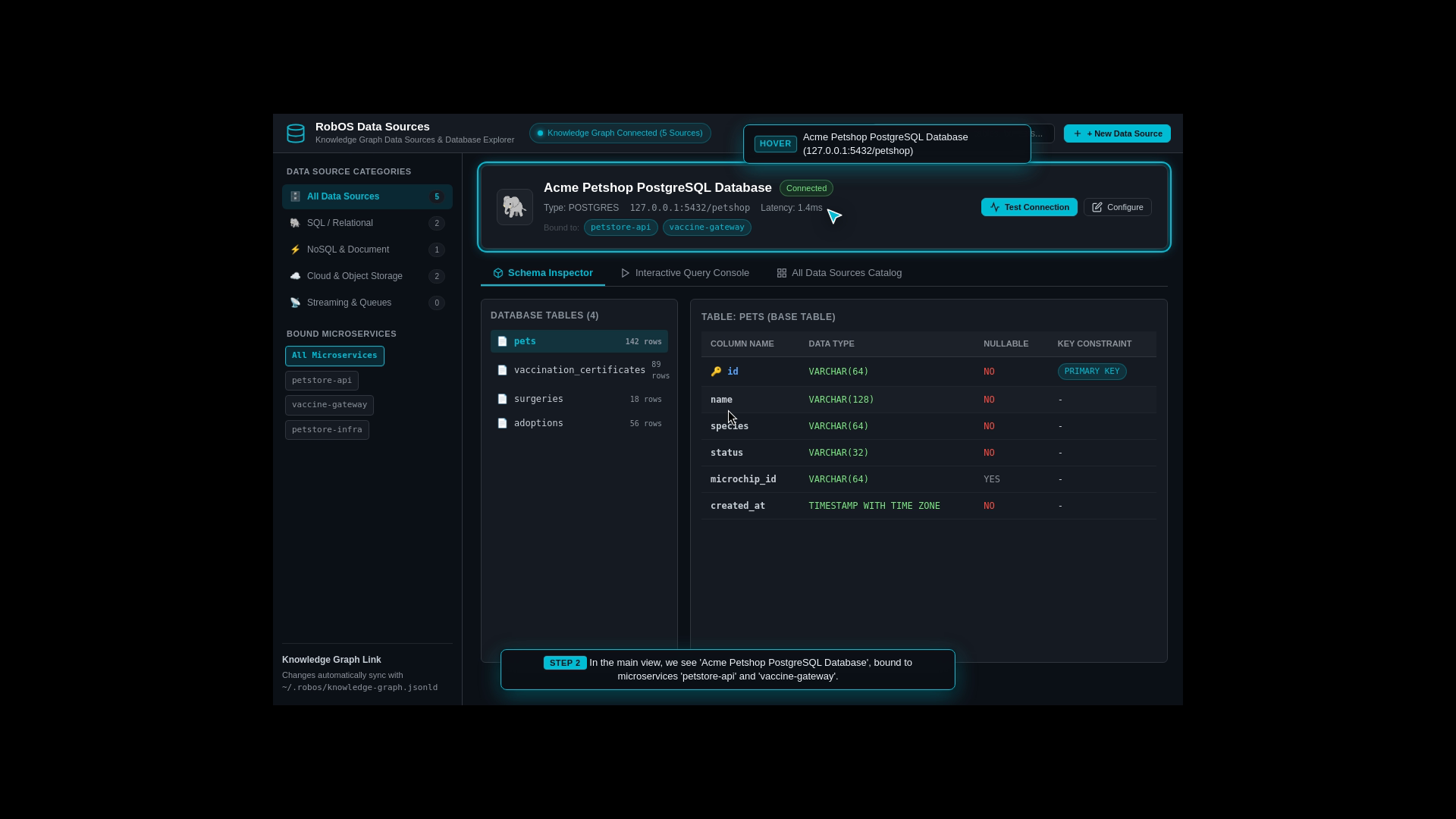
3. RobOS Data Sources Explorer (data-sources)
The central connection hub that maps physical data stores directly to architectural topology nodes:
- Links live databases, Kafka streaming topics, OpenSearch domains, and AWS S3 contract vaults to their corresponding
robos:Microserviceconsumers. - Real-time connection testing: Verifies network reachability, TLS handshakes, and authentication health in under 100ms.
- Zero-Plaintext Security: Connection strings and passwords are encrypted in the local UNIX password store (
pass) via GPG.
Architectural Grounding: Bridging Data to the Knowledge Graph
Unlike isolated third-party tools, RobOS connects live data sources directly into the SDLC Knowledge Graph:
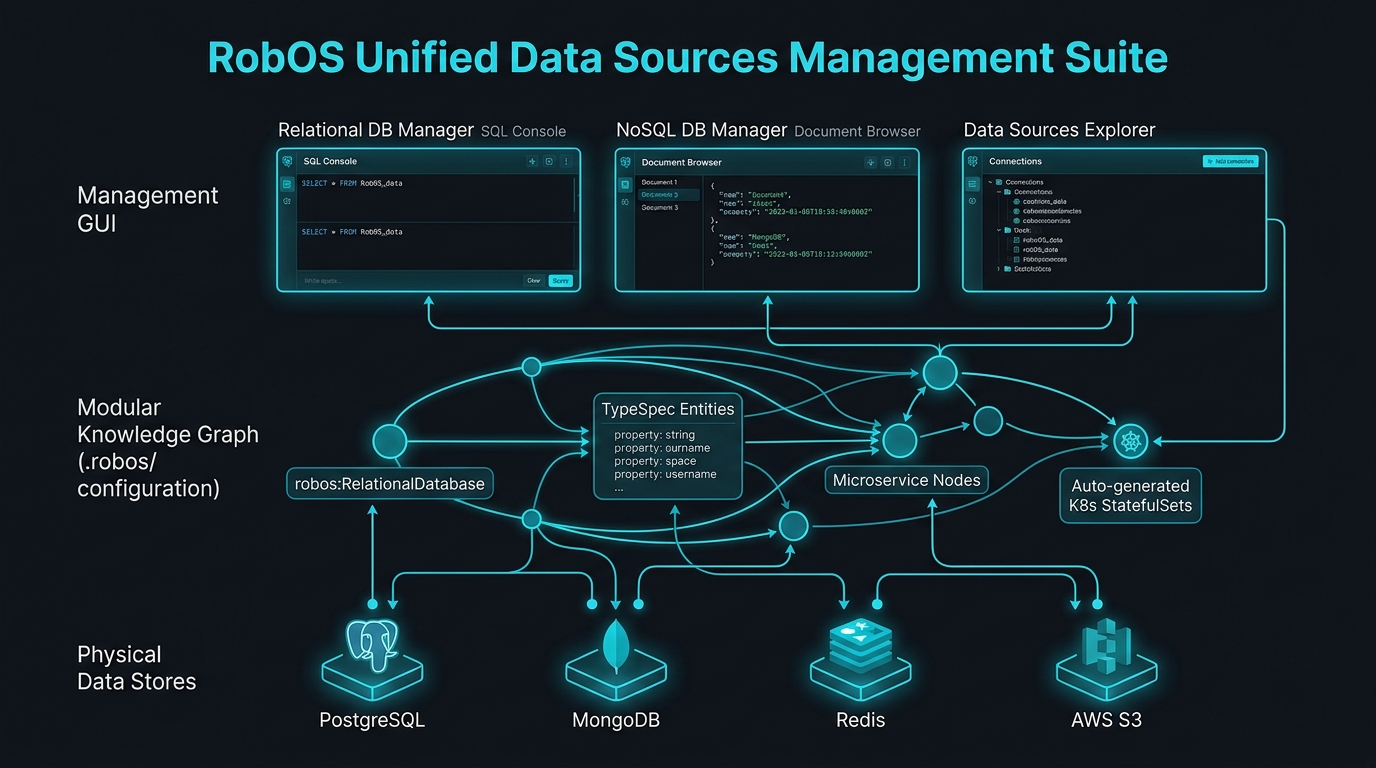
- Automated Entity Model Synthesis: When you connect to an existing database, RobOS can introspect table structures and automatically synthesize Microsoft TypeSpec domain models and TypeScript/Java entity definitions.
- Contract & Blast Radius Enforcement: If a developer proposes dropping or renaming a database column in World 2 (feature branch), the Knowledge Graph flags all microservices that query that table before the migration script is run.
Next Steps
- Explore RobOS Main Wins: Return to the Main Wins executive overview.
- Universal Web & API Clients: Connect microservice clients with database persistence.
- 100% Declarative GitOps: Learn how visual databases compile into Kubernetes StatefulSets.
- Browse All 30+ Apps: Inspect detailed specifications for the entire application suite.
- 💡 Explore the Ideas Store on GitHub: View raw idea dumps, community feature proposals, and structured architecture specs.