
Security & Isolation Proofs
End-to-end verified security architectures, Linux network namespace sandboxes, kernel kill-switch proofs, and zero-leak audits in RobOS.
Table of contents
Zero-Leak OpenVPN App Sandbox & 3-Barrier Kernel Kill-Switch Proof
RobOS VPN Servers (packages/vpn-servers) and RobOS VPN Sandbox (packages/vpn-sandbox) allow any desktop or CLI executable (such as Firefox, Transmission, or curl) to be launched inside an isolated Linux network namespace (ip netns) bound to an OpenVPN provider (with 3,598 official IPVanish .ovpn server profiles bundled out of the box).
[!IMPORTANT] Even if the OpenVPN daemon crashes or is force-killed (
SIGKILL) mid-session while the application is actively running, three independent Linux kernel firewall barriers guarantee that zero packets can fall back to the host’s normal public IP.
End-to-End Application Captures
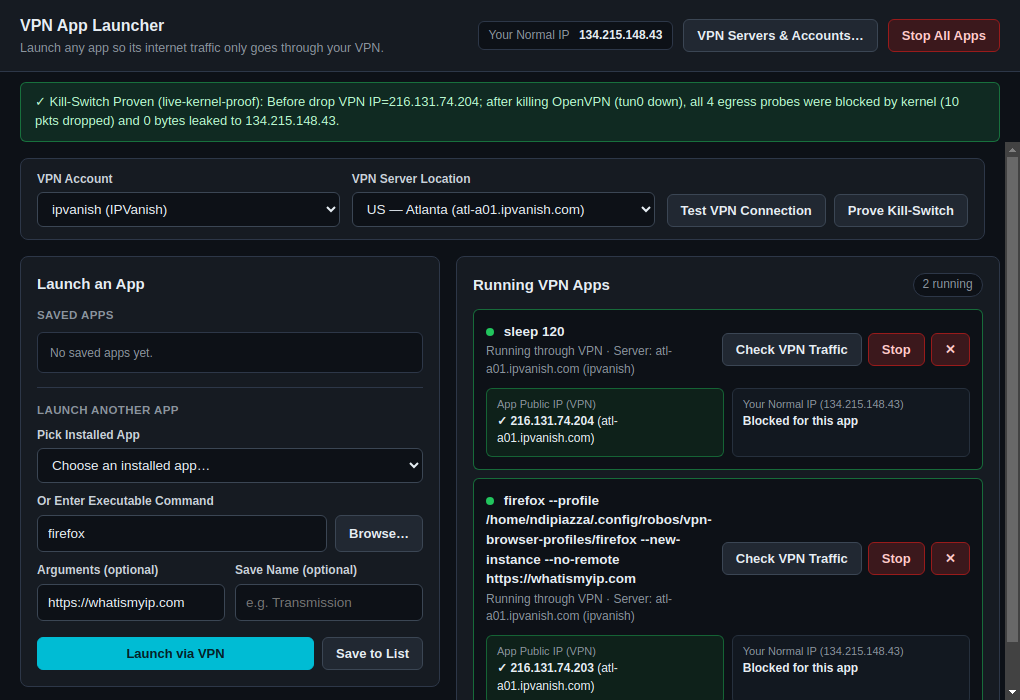
| RobOS VPN Servers (Account & 3,598 Profiles) | RobOS VPN Sandbox (Active Namespace Session) |
|---|---|
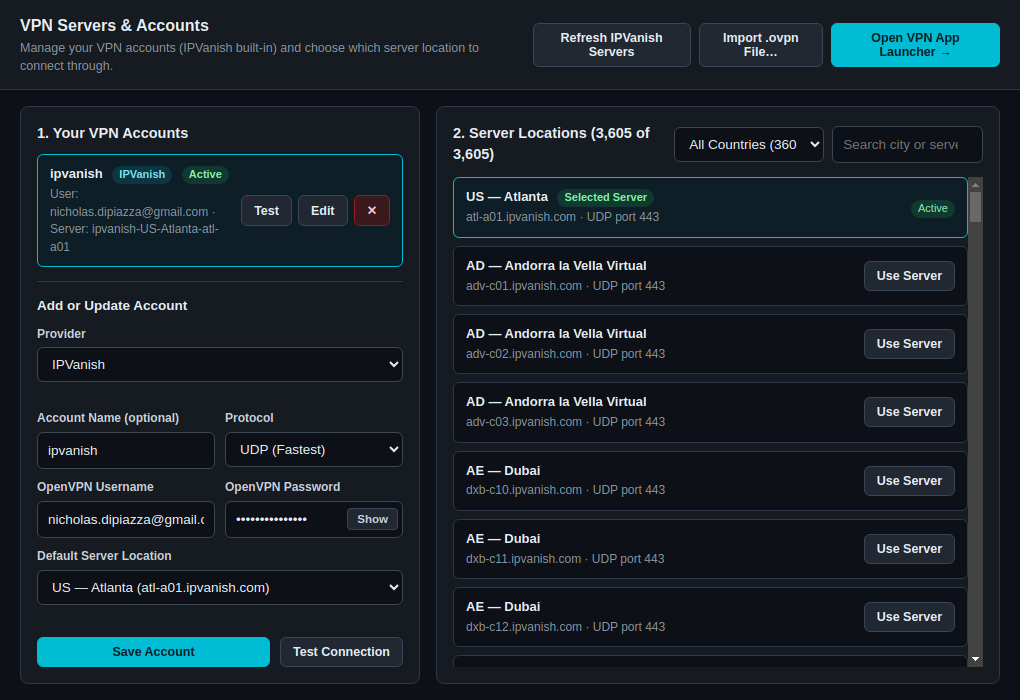 | 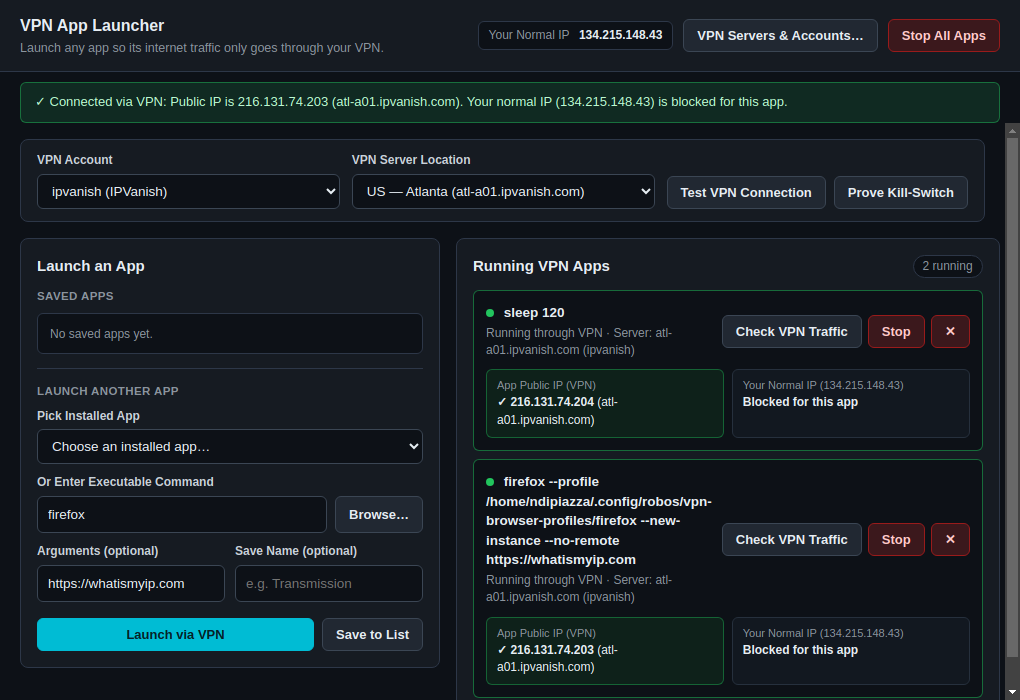 |
3-Barrier Kernel Kill-Switch Architecture
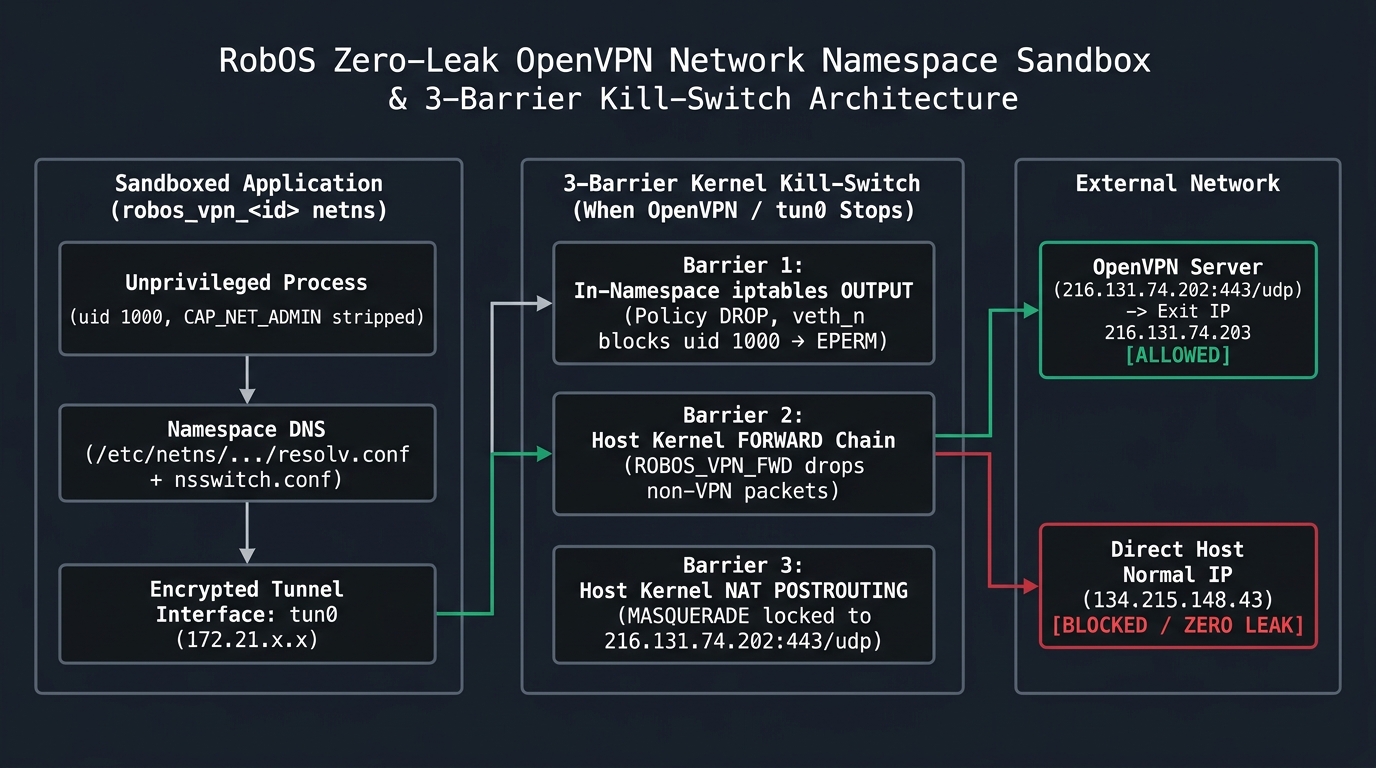
flowchart LR
  subgraph NS["Isolated Linux Network Namespace (robos_vpn_25db)"]
    APP["Sandboxed App (Firefox / Transmission)<br/>uid=1000, CAP_NET_ADMIN stripped"]
    DNS["Namespace DNS & NSS<br/>/etc/netns/robos_vpn_25db/resolv.conf<br/>nsswitch.conf: hosts: files dns"]
    IPT_NS["Barrier 1: In-Namespace iptables OUTPUT<br/>Policy: DROP<br/>1. -o lo ACCEPT<br/>2. -o tun+ ACCEPT<br/>3. -o veth_n_25db -d 216.131.74.202:443/udp -m owner --uid-owner 0 ACCEPT<br/>4. -o veth_n_25db DROP (blocks uid 1000 -> EPERM)"]
    OVPN["OpenVPN 2.7 Daemon<br/>uid=0 (--dns-updown disable)"]
    TUN0["tun0 (172.21.23.221)"]
    VETH_N["veth_n_25db (10.203.41.2/30)"]

    APP --> DNS
    APP -->|Allowed when tun0 UP| TUN0
    TUN0 --> OVPN
    OVPN -->|uid=0 encrypted UDP:443| IPT_NS
    APP -.->|When tun0 DOWN: falls back to default route| IPT_NS
    IPT_NS -->|uid=0 ONLY to 216.131.74.202:443| VETH_N
  end

  subgraph HOST["Host Kernel (enp2s0 — Normal Public IP 105.42.88.19)"]
    VETH_H["veth_h_25db (10.203.41.1/30)"]
    IPT_FWD["Barrier 2: Host FORWARD Chain (ROBOS_VPN_FWD_25db)<br/>ACCEPT only 10.203.41.2 -> 216.131.74.202:443/udp<br/>DROP all other packets from veth_h_25db"]
    IPT_NAT["Barrier 3: Host NAT POSTROUTING<br/>MASQUERADE only -s 10.203.41.2 -d 216.131.74.202:443/udp<br/>No NAT rule exists for any other destination"]
    VETH_N --> VETH_H
    VETH_H --> IPT_FWD
    IPT_FWD --> IPT_NAT
  end

  subgraph EXT["External Internet"]
    VPNSRV["IPVanish Server (atl-a01)<br/>216.131.74.202:443/udp<br/>Exit IP: 216.131.74.203"]
    REALIP["Direct Host Egress (105.42.88.19)<br/>UNREACHABLE FROM SANDBOX"]
    IPT_NAT -->|Encrypted OpenVPN Carrier| VPNSRV
    IPT_FWD -.->|0 packets allowed| REALIP
  end
- Barrier 1 — In-Namespace
iptablesDefault-DROP + UID Owner Lock (-m owner --uid-owner 0):- The application runs as the unprivileged desktop user (
uid 1000) withsetpriv --inh-caps=-net_admin,-net_raw. - Inside
robos_vpn_<id>,iptables -P OUTPUT DROPandip6tables -P OUTPUT DROPreject all traffic by default. - Only
-o tun+is permitted foruid 1000. Onveth_n_<id>, onlyuid 0(openvpn) to<vpn_server_ip>:<vpn_port>is accepted, followed by-A OUTPUT -o veth_n_<id> -j DROP. - When OpenVPN stops and
tun0disappears, packets from the app fall back todefault via 10.203.X.1 dev veth_n_<id>and immediately hit-A OUTPUT -o veth_n_<id> -j DROP(EPERM).
- The application runs as the unprivileged desktop user (
- Barrier 2 — Host Kernel
FORWARDChain (ROBOS_VPN_FWD_<id>):- The host kernel only forwards packets arriving on
veth_h_<id>(10.203.X.2/32) if they are addressed to<vpn_server_ip>/32:<vpn_port>and drops all other packets before NAT.
- The host kernel only forwards packets arriving on
- Barrier 3 — Destination-Scoped Host
POSTROUTINGNAT:- The
MASQUERADErule innat POSTROUTINGonly matches-s 10.203.X.2/32 -d <vpn_server_ip>/32 -p udp --dport 443. No NAT translation rule exists to translate namespace packets to the normal host IP (105.42.88.19) for any other destination.
- The
Reproducing the Live 5-Phase Kill-Switch E2E Proof
ROBOS_VPN_LIVE_E2E=1 node --test tests/e2e/vpn-sandbox-killswitch-proof.test.cjs
| Phase | Verification Step | Result |
|---|---|---|
| 1. Host Baseline | Query https://api.ipify.org outside the sandbox | Normal public IP is 105.42.88.19 |
| 2. Tunnel UP Egress | Query https://api.ipify.org inside robos_vpn_25db as uid 1000 while tun0 is UP | Returns VPN exit IP 216.131.74.203 (tun0 = 172.21.23.221) |
| 3. Force-Kill OpenVPN | kill -9 OpenVPN PID while keeping robos_vpn_25db and veth_n_25db default route UP | tun0 destroyed (true), default via 10.203.41.1 dev veth_n_25db still UP (true) |
| 4. Post-Kill Egress Probes | Attempt HTTPS (api.ipify.org), direct TCP (1.1.1.1:80), direct UDP (8.8.8.8:53), and direct UDP to VPN server IP as uid 1000 | All 4 blocked (EAI_AGAIN, ETIMEDOUT, EPERM, EPERM) — ipLeakedAfterDrop: false |
| 5. Kernel Packet Counters | Inspect ip netns exec robos_vpn_25db iptables -L OUTPUT -v -n -x | 14 packets (1,070 bytes) dropped by -A OUTPUT -o veth_n_25db -j DROP; 0 leaked |