
Combat, party and spells
How combat works in the real-time scenes of games/crpg-realm: the attack formula and the numbers each scene passes to it, the Malakor boss fight, party formations, enemy targeting and the spell code. The data-driven rules engine used by the tests is separate and is covered on the testing page.
On this page
How an attack resolves
CombatManager.execute_attack(attacker_name, attack_bonus, damage_dice_min, damage_dice_max, target_name, target_ac, target_pos) is the one melee roll. execute_ranged_attack is the same with different condition rules. The function:
- Rolls two d20s. If the attacker has
blinded,poisoned,frightenedorprone(disadvantage) and not also an advantage condition, it keeps the lower roll. If the target isblinded,paralyzed,prone,stunnedorunconscious(advantage) it keeps the higher. Both cancel out. - A
blessedattacker adds 1d4 to the attack bonus. Ashieldon the target adds 5 to its AC, andhastedadds 2. - A natural 20 is a critical hit and always hits. A natural 1 always misses. Otherwise it hits if
d20 + attack_bonus >= target_ac. Aparalyzedorunconscioustarget is always critically hit. - Damage is a random integer between
damage_dice_minanddamage_dice_max. A critical hit rolls that range twice and adds the results. There are no dice expressions and no ability modifier.
It returns {d20, total_attack, hit, crit, damage}, logs the roll to the activity log and shows floating text.
The numbers come from the caller. Each scene script hard-codes them, and equipped weapons and ability scores do not feed in:
| Caller | Attacker | Bonus | Damage | Target AC |
|---|---|---|---|---|
VillageSquare melee at the hound | hero | +8 | 24 to 30 | the hound’s armor_class |
VillageSquare ranged at the hound | hero | +6 plus DEX modifier | 24 to 30 | same |
WhisperingForest | hero | +7 | 20 to 30 | the beast’s AC |
AncientCatacombs | hero | +8 | 22 to 30 | the target’s AC |
GarrisonKeep | hero against Malakor | +8 | 18 to 26 | 14 |
GarrisonKeep | Malakor against hero | +5 | 2 to 6 | GameState.hero_ac |
TacticalBattle | hero | +10 | 30 to 32 | the enemy’s armor_class |
Several callers ignore the result. VillageSquare calls hound.take_damage(99) whatever was rolled, and TacticalBattle.execute_hero_attack_on_enemy() applies randi_range(30, 32) damage even on a miss. These scenes check the flow, not balance.
TacticalEnemy rolls its own attack every 2.4 seconds while in the attack state: d20 plus attack_bonus against the target’s AC, then a random integer from damage_min to damage_max. At 0 HP the hero gets unconscious and GameState.check_party_defeat() runs. The six-second round counter (GameState.ie_round) only timestamps events. There is no initiative order or turn order in these scenes.
The Malakor fight
The fight is scripted entirely in scripts/GarrisonKeep.gd. Malakor is not a TacticalEnemy. He is the MalakorBoss node: an Area2D running ClickableObject.gd, with a sprite, label, BossHPBar, BossHPText and collision shape. His HP and AC are variables and literals in the scene script, 48 HP and AC 14, although monsters.json lists captain-malakor-boss with 58 HP and AC 16.
flowchart TD
    A["Click MalakorBoss (body_clicked)"] --> B["confront_malakor()"]
    B --> C["ActionLog.start_dialogue: tree malakor-showdown"]
    C --> D["dialogue_ended (one shot)"]
    D --> E["start_boss_battle(): boss_fight_active = true"]
    E --> F["execute_boss_round()"]
    F --> G["hero attack: +8, 18 to 26, AC 14"]
    G --> H{"malakor_hp <= 0 after 0.6 s?"}
    H -- yes --> V["_on_malakor_vanquished()"]
    H -- no --> I["Malakor attack: +5, 2 to 6, hero AC"]
    I --> J["wait 1.2 s, next round"]
    J --> F
    V --> K["flags.malakor_slain, add_kill, advance_quest(5)"]
    K --> L["load VictoryScreen.tscn"]
- A click from anywhere starts it. There is no range check.
- The
malakor-showdowntree indata/v1/dialogue.jsonruns first. Itsnode_fighthas an emptychoicesarray, which makes the log show one continue button; closing the dialogue emitsdialogue_endedand starts the loop. If you rename the tree, change the id inconfront_malakor()too. If the tree is missing, the dialogue closes before the signal is connected and the fight never starts. - The loop alternates a hero swing and a Malakor swing until his HP is 0, then sets
flags.malakor_slain, callsGameState.advance_quest(5)and loadsVictoryScreen.tscn, which shows name, class, kills, chests and gold, with a replay button. - The loop ignores party defeat, and it does not stop if the
attack_malakorAPI action starts a second loop beside it, which can run the victory function twice. Not built: boss phases, shields, summoned minions, initiative.
To make the fight read monsters.json, add a malakor_ac variable, set malakor_max_hp, malakor_hp and the AC from DataStore.monsters["captain-malakor-boss"] (a MonsterData with hit_points and armor_class) in _ready(), update the BossHPBar maximum (the scene hard-codes 48), and use the variable in execute_boss_round(). To add a phase, keep a phase variable, check malakor_hp * 2 <= malakor_max_hp after the hero’s swing, and use phase-dependent attack numbers in his strike.
The HTTP actions for the fight are confront_malakor, attack_malakor (calls execute_boss_round()) and defeat_malakor, which sets the flag and loads the victory screen without running the fight. Full playthrough features 01 to 04 finish with defeat_malakor, so they do not exercise the loop. Features 05 and 06 click MalakorBoss, so they do.
Party and formations
Data and nodes
| What | Where |
|---|---|
| Party data | GameState.party_members (array of dictionaries). Index 0 is the hero. |
| Hero node | HeroPlayer.tscn, named HeroPlayer. Owns the camera and handles input. |
| Companion nodes | PartyCompanion.tscn, a separate and smaller class with companion_id and companion_name exports |
| Leader | GameState.party_leader_index, default 0 |
| Formation | GameState.current_formation, default "rank" |
GameState.get_scene_party_nodes() maps data to nodes: index 0 is the node named HeroPlayer, and each later member is the direct child CharacterBody2D whose companion_id or companion_name matches. TacticalBattle.tscn places two companions, CompanionElora and CompanionThrumbar; the location scripts add one PartyCompanion in _ready() when the party has more than one member.
set_party_leader(idx) is the only call that changes the leader. A left-click on a portrait calls select_party_member(idx) and then set_party_leader(idx). The keys 1, 2 and 3 only select. The camera stays a child of HeroPlayer and adds the offset to get_leader_node() each frame.
The six formations
GameState.FORMATIONS maps an id to six slot offsets, written for a party walking up the screen, so a positive y is behind the leader. Slot 0 is the leader’s.
| id | Log title | Slot 0 | Slot 1 | Slot 2 | Slot 3 | Slot 4 | Slot 5 |
|---|---|---|---|---|---|---|---|
rank | Rank & File | (0, 0) | (48, 0) | (0, 48) | (48, 48) | (0, 96) | (48, 96) |
wedge | Wedge (V-Formation) | (0, 0) | (-48, 44) | (48, 44) | (-96, 88) | (96, 88) | (0, 75) |
line | Shield Wall (Abreast) | (0, 0) | (48, 0) | (-48, 0) | (96, 0) | (-96, 0) | (144, 0) |
column | Marching Column | (0, 0) | (0, 48) | (0, 96) | (0, 144) | (0, 192) | (0, 240) |
square | Defensive Square | (-35, 0) | (35, 0) | (-35, 70) | (35, 70) | (0, 35) | (0, 100) |
scatter | Skirmish (Scatter) | (0, 0) | (-70, 35) | (65, 50) | (-40, 85) | (80, 100) | (0, 120) |
get_formation_offsets() rotates each offset by the travel angle plus 90 degrees, so the shape turns to face the direction of travel. An unknown id falls back to rank, and a seventh member gets (0, 48 * i).
A left-click that no UI control handles reaches HeroPlayer._unhandled_input(), which calls GameState.move_party_formation(click_pos, is_shift). The leader gets slot 0 and the others get slots 1, 2 and so on in party order, skipping the leader. Each member’s destination is the click plus its rotated offset. Between clicks, a PartyCompanion that is not the leader walks toward its slot next to the leader whenever it is more than 65 px away, except in TacticalBattle, where only explicit orders move it.
To add a formation, add a key with six offsets to FORMATIONS, add a match case for its log title in set_party_formation(), copy a formation button in scenes/components/ActionToolbar.tscn, and wire it in ActionToolbar.gd (a find_child, a pressed connection and an entry in _update_formation_buttons). The HTTP action formation_<id> works without edits.
Limits: companions do not use Pathfinder (they walk straight and slide on walls), square puts the leader 35 px off the click, and HeroPlayer follows slot 1 when a companion leads. Test with normal/14_party_independent_dynamics_and_formations.feature.
Enemies and threat
Two enemy scripts exist.
| Script | Used in | Behaviour |
|---|---|---|
TacticalEnemy.gd (scene components/TacticalEnemy.tscn) | TacticalBattle.tscn: EnemyWolfAlpha, EnemySkeletonArcher, EnemyShadowStalker | Threat table, proximity aggro, pack alerts. Every stat is an @export; it does not read monsters.json. |
ShadowHound.gd (scene ShadowHound.tscn) | VillageSquare, WhisperingForest, AncientCatacombs | Patrols and chases the hero within 190 px. No threat table or pack logic. The location script handles the fight. |
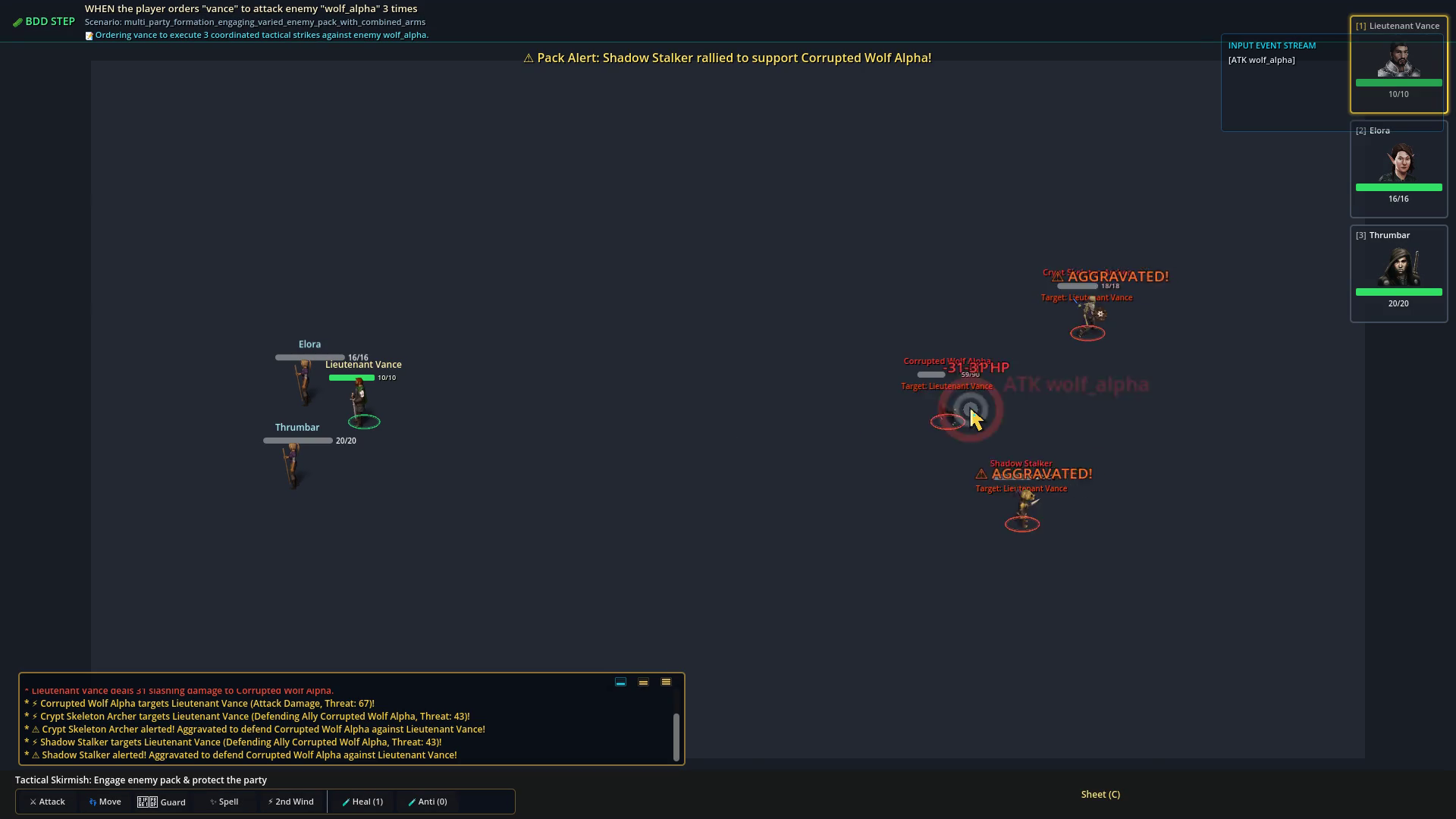 From the pack-alert scenario in
TacticalBattle. Read the log at the bottom: the wolf targets Vance with a threat value, and the archer and stalker are alerted to defend their ally.
The rest of this section is about TacticalEnemy.
| Export | Default | Meaning |
|---|---|---|
aggro_radius | 280 | A hostile enemy on patrol targets the closest party member inside this radius |
pack_friend_radius | 480 | After a proximity aggro, allies inside this radius rally |
pack_alert_radius | 950 | After an enemy takes damage, allies inside this radius join in |
friends | none | Enemy ids that always count as allies, at any distance, in both directions |
is_hostile | true | false ignores proximity and alerts; damage still builds threat |
max_hp, armor_class, attack_bonus, damage_min, damage_max | 28, 13, 4, 4, 10 | Stats |
is_ranged, ranged_standoff_distance | false, 240 | Ranged enemies stop at the standoff distance |
waypoints | none | Patrol route. With none, the enemy stands still. |
The state machine is PATROL, CHASE, ATTACK, DEAD. It re-checks proximity every 0.45 seconds. Chasing walks straight at the target (no pathfinding) until within 50 px (or the standoff distance), then attacks every 2.4 seconds, and falls back to chasing beyond 65 px. The corpse stays and can be looted.
Threat. Each enemy keeps a threat_table and a direct_damage_table, keyed by display name. A hit adds damage * 2 + 10 threat. The enemy switches target when it has none, when its target has dealt no damage yet and the new source has, or when the new source’s threat exceeds int(current * 1.15) + 3. Proximity aggro does not write threat, only a log value of 30, so the first party member to deal damage takes the enemy over. force_taunt(source, threat) switches unconditionally; TacticalBattle.execute_taunt_on_enemy calls it with 60, and only the HTTP action taunt_enemy reaches that.
Pack alerts. Damage from an attacker calls _alert_friends, which gives each living hostile TacticalEnemy sibling that is linked or within pack_alert_radius threat of int(damage * 0.75) + 35 (linked) or + 20 (not). Proximity aggro calls _alert_friends_proximity for allies within pack_friend_radius or linked, with threat 25. take_damage(amount, attacker) needs a real attacker node to build threat and alert the pack; with null it only lowers HP.
To place a pack, instance TacticalEnemy.tscn twice as direct children of the scene root, set stats, enemy_id, a sprite_texture_path and friends on each, and connect body_clicked in the scene script so clicks do something. Do not add enemies to TacticalBattle.tscn: feature normal/06_infinity_aggro_threat_and_target_switching.feature asserts it contains 3. That feature covers threat switching, taunt, pack alerts, proximity rally and a passive enemy.
Spells
Where the code is
Spells in the real-time scenes are resolved by match blocks on the spell id in scripts/CombatManager.gd:
| Method | Handles |
|---|---|
execute_cast_spell(caster_name, spell_id, target_name, target_node) | magic-missile, cure-wounds, healing-word, shield, sleep, mage-armor, burning-hands, thunderwave, bless, hold-person, spiritual-weapon, fireball, lightning-bolt, blizzard, stinking-cloud, haste, counterspell, find-traps, knock, invisibility, dispel-magic, sanctuary, see-invisibility, and the fighter abilities tremor-stomp, crushing-cleave, rallying-stomp |
execute_aoe_spell(caster_name, spell_id, target_center, radius = 180, save_dc = 14, save_stat = "DEX", caster_node) | fireball, burning-hands, thunderwave, lightning-bolt, blizzard, stinking-cloud, sleep |
Before the match, execute_cast_spell refuses a target that is invisible (unless the caster can see invisible) or under Sanctuary (except for cure-wounds, healing-word and sanctuary). An id with no branch hits the default: it logs “X casts Y!” and returns success: true without doing anything.
data/v1/spells.json has 26 entries. Each now has a mechanics block that the scenario engine reads, but DataStore.spells is not read by any gameplay script. So a new spell for the real-time scenes needs a branch in CombatManager.gd. Add the JSON entry as well, so the scenario engine and the lists know the spell.
TacticalBattle.execute_spell_cast() is what the HTTP cast_spell action calls in TacticalBattle. It sends the seven area ids to execute_aoe_spell(..., hero) and everything else to execute_cast_spell(). Radius and save: fireball 180 px (DC 14 DEX), burning-hands 150 px (DEX), thunderwave 150 px (CON), lightning-bolt 450 px (DEX), and blizzard, stinking-cloud and sleep from GameState.SPELL_AOE_FEET, which is 20 ft at 9 px per foot, so 180 px (stinking-cloud saves with CON).
Fireball
fireball rolls eight d6 once (8d6) and shares the total across all targets. Candidates are the scene’s enemies dictionary (TacticalBattle has one) plus every TacticalEnemy that is a direct child of the scene. Each living candidate within radius pixels of the point rolls d20 plus its dex_save_mod export (default 2) against the DC, and takes half damage, rounded up, on a pass. take_damage(dmg, caster_node) builds threat and alerts the pack only when caster_node is not null. The return value has the dice, the total, the DC and a targets_hit list with each target’s save and HP before and after. The HTTP API returns it as telemetry.
Visuals
HeroPlayer.play_cast_spell(spell_id, target_pos, on_cast_callback) plays the cast animation. Some spells have their own effect function; the rest, fireball included, use a generic orb that flies to the target and bursts. The rules and the visual are separate: the caller invokes CombatManager, usually from the callback. Projectile and burst meshes come from scripts/SpellModel3D.gd.
The toolbar Spell button
ActionToolbar uses only the first prepared spell. cure-wounds heals the hero. find-traps calls cm.cast_spell, which CombatManager does not define, so it raises an error in any scene with a CombatManager. Any other spell looks for a node named BlightHound, which no scene contains, and does nothing. Cast spells through the HTTP cast_spell action in TacticalBattle for now.
Add a spell
- Add an object to
data/v1/spells.json. Include amechanicsblock if you want the scenario engine to cast it. - In
CombatManager.execute_cast_spell(), add a branch above the final_:branch. Followmagic-missile: log with_log_combat, playspell_castandspell_impactthroughAudioManager.play_sfx, apply damage withtarget_node.take_damage(...), and return a dictionary withsuccess.ShadowHound.take_damage(amount)takes one argument andTacticalEnemy.take_damage(amount, attacker = null)takes two. - Test it with a feature under
tests/e2e/features/spells/. Use the existing steps fromspell_01_magic_missile.feature:Given an isolated tactical spell encounter "combat_dummy" with hero "Ignis" class "wizard" and 35 HP,When the hero targets "dummy_1" and casts spell "<id>",Then the spell "<id>" resolves successfully.resolves successfullyalone proves little, because the default branch also returns success, so add checks on damage or log text.
sanctuary and see-invisibility have no file in spells/. They are covered by normal/17_invisible_enemy_and_sanctuary_targeting.feature.