
Tabletop RPG (HeroQuest engine)
A turn-based dungeon crawler in Godot 4.3, modelled on the HeroQuest board game, in games/tabletop-rpg. This page covers how to run it, what it contains, and how its parts fit together.
On this page
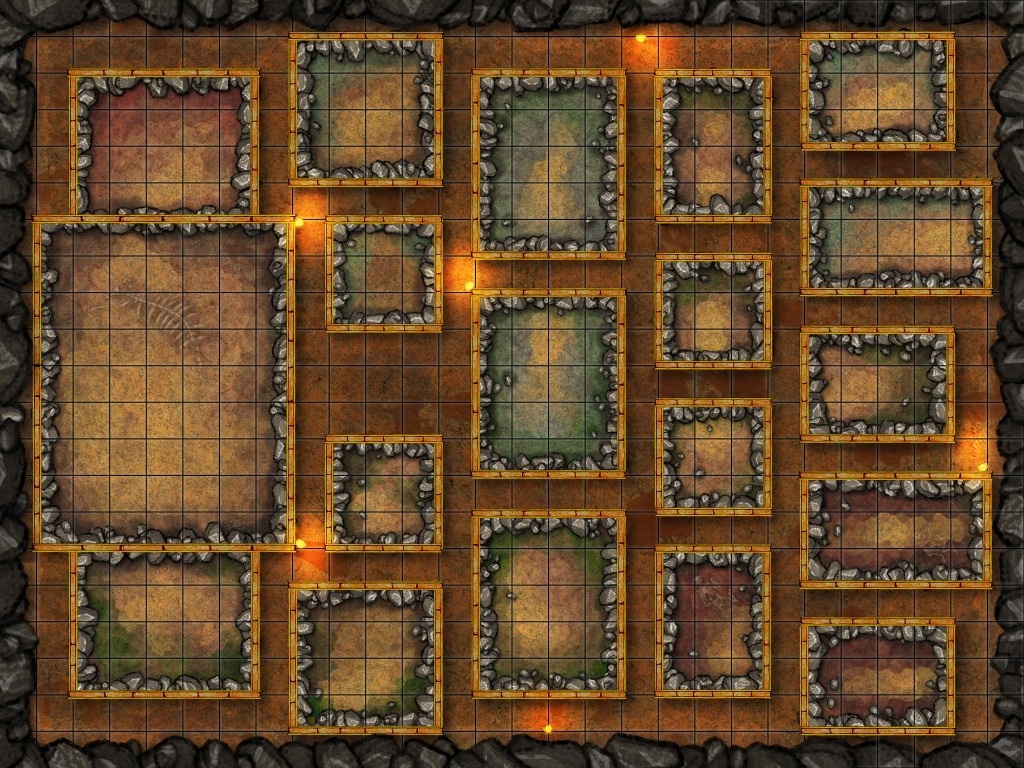
The Fan Dungeon board image, the 28x21 map used by Quest 1. Rooms are the walled areas; the open space between them is corridor.
Run it
You need Godot 4.3, the version project.godot targets (GL Compatibility renderer). The game does not bundle it. play.sh looks for the binary in $GODOT_BIN, then ~/.local/bin/godot, ~/apps/godot4, and godot4 or godot on your PATH. It exits with an error if none exists.
./games/tabletop-rpg/play.sh                   # launches the verified Quest 1: Custom Dungeon
./games/tabletop-rpg/play.sh --demo            # watch Mentor AI solve the quest autonomously
./games/tabletop-rpg/play.sh --dm              # play the Game Master (Zargon) instead of the heroes
./games/tabletop-rpg/play.sh --hard --reset    # hard mode, fresh campaign save
./games/tabletop-rpg/play.sh --headless --demo
Other flags in play.sh: --reset starts a new game instead of resuming, --player selects the hero side, and --hard sets hard mode. By default, it loads the verified playable cartridge custom-quest.cartridge.json.
What is in the game
The game loads a cartridge, a single .cartridge.json file that holds heroes, monsters, quests and maps. Two verified playable cartridges ship in games/tabletop-rpg/cartridges/:
| Cartridge | Quests | Maps | Verification |
|---|---|---|---|
custom-quest | Quest 1: Custom Dungeon. Vanquish the Dungeon Boss, explore ancient chambers, and escape to border stairs [-1, 4]. | Classic board, 28x19 grid. | 100% Verified Playable: 296 turns, 21 combat rounds, 315 audit transactions, 0 casualties. |
election-2026-quest-1 | Election 2026: Battle for the Hill. Lead the bipartisan party (Barack Obama, Donald Trump, Hillary Clinton, Bernie Sanders) through the Capitol catacombs to slay all 3 two-headed Hydras (Talarixon, Brownsted, El-Rogers). | Capitol Catacombs, 26x19 grid. | 100% Verified Playable: 266 turns, 15 combat rounds, 283 audit transactions, 4/4 heroes alive. |
The rules in code:
- Movement. A hero rolls 2d6 for movement (
TabletopDice.gd). - Combat. Each combat die has three skulls, two white shields and one black shield. Wounds are the attacker’s skulls minus the defender’s shields, to a minimum of zero. A defending hero counts white shields and a defending monster counts black shields.
- Fog of war. Rooms stay hidden until a hero opens a door into them.
- Spells.
HeroQuestSpells.gddefines 12 spells in four decks (fire, earth, water, air), plus 10 dread spells for the Game Master.
The four heroes in the Quest 1 cartridge:
| Hero | Body | Mind | Attack dice | Defend dice |
|---|---|---|---|---|
| Barbarian | 8 | 2 | 3 | 2 |
| Dwarf | 7 | 3 | 2 | 2 |
| Elf | 6 | 4 | 2 | 2 |
| Wizard | 4 | 6 | 1 | 2 |
How the parts fit
| Part | Location | Role |
|---|---|---|
| Game | games/tabletop-rpg | Godot project. Main scene TabletopWorld.tscn; autoloads for dice, cartridges, spells, equipment and the control server. |
| Shared library | packages/robos-gaming | Node.js code for dice, a board grid with walls and doors, three map configurations, a cartridge bundler that validates a cartridge, and the gaming ontology with its SHACL shapes. |
| Knowledge graph | .robos/kgraphs/tabletop-game | The robos.tabletop package: heroes, monsters, spell cards, furniture, map configurations and test scenarios. Hero nodes refer to starting weapons defined in the robos.game package in .robos/kgraphs/game. |
| Cartridge editor | RobOS Tabletop Studio | Electron app for editing cartridge data. |
| Map tool | Tabletop Blockmap Creator | Electron app for calibrating a grid over a dungeon image and drawing corridors and rooms. |
Control API
While the game runs, GameControlServer.gd listens on 127.0.0.1:18092. Set TABLETOP_SERVER_PORT to use another port.
| Request | Purpose |
|---|---|
GET /api/v1/health | Liveness check. |
GET /api/v1/state | Current game state as JSON. |
GET /api/v1/cartridges | Discovered cartridges and the active one. |
POST /api/v1/action | Run a game action, such as rolling movement, moving, opening a door or attacking. |
POST /api/v1/cartridge/insert | Load a different cartridge. |
POST /api/v1/screenshot | Save a PNG to the path in the request body. |
rpc_ai/tabletop_qa_player.py is a Python client for this API. rpc_ai/tabletop_rpc_ai.py builds on it to play whole turns.
Tests
The library tests need only Node.js:
npm --prefix packages/robos-gaming test
The game has 60 test_*.py files in games/tabletop-rpg/tests. 58 of them launch the game through play.sh, typically with --headless and a dedicated port. They then drive the game through the control API with TabletopQAPlayer and assert on the returned state. They need a Godot binary. Run one directly:
python3 games/tabletop-rpg/tests/test_tabletop_cartridge.py
tests/record_tabletop_gameplay.py plays a scripted session in a virtual display (Xvfb at 1920x1080), records it with FFmpeg and writes an MP4 and a WebVTT caption file to ~/.robos/development/walkthroughs/tabletop-gameplay/.
Proof of Viability (Autonomous Quest Verification)
How do you prove a newly authored cartridge is actually winnable before shipping? RobOS uses autonomous agent governance to verify that the heroes can solve the dungeon, uncover secret passageways, survive combat balance, and reach extraction stairs.
Pipeline Architecture
flowchart LR
    subgraph S1["Stage 1: Quest Map Authoring"]
        BC["Tabletop Blockmap Creator"] --> QE["Tabletop Quest Map Editor"]
        QE --> CB["Cartridge Bundler"]
        CB --> QC[("Quest Cartridge JSON")]
    end

    subgraph S2["Stage 2: Mentor AI Engine"]
        QC --> GR["Godot 4 Headless Runner"]
        GR --> API["Control API (:18092)"]
        API --> DT{"Decision Tree"}
        DT -->|cur_bp <= 4| PT["Emergency Potion Triage"]
        DT -->|Adjacent enemy| CT["Combat & Spellcasting"]
        DT -->|Undiscovered exits| SD["Secret Door Search"]
        DT -->|Clear path| EX["Border Exit Navigation [-1, 4]"]
    end

    subgraph S3["Stage 3: Verification Artifacts"]
        EX --> AL["315-TX Audit Ledger"]
        EX --> SS["Turn-by-Turn Screenshots"]
        EX --> PR["Interactive Viability Report"]
    end
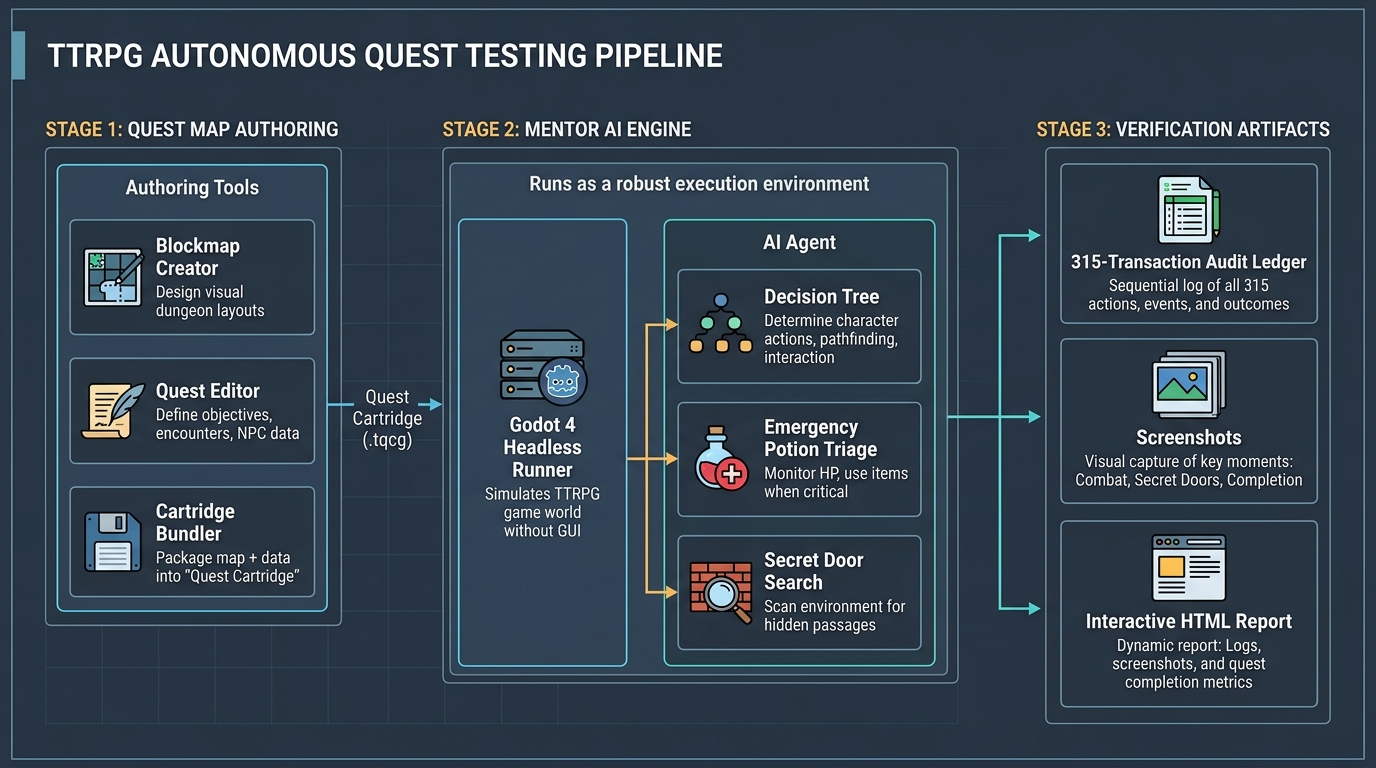
The end-to-end autonomous proof is implemented in games/tabletop-rpg/tests/test_demo_custom_quest_e2e.py. It runs the four heroes autonomously on custom-quest.cartridge.json, verifying:
- Starting Healing Potions & Emergency Consumption: All 4 heroes are provisioned with 2 healing potions each; Mentor AI monitors health and drinks a potion whenever
cur_bp <= 4(+4 BP,USE_ITEMtransaction). - Dynamic Room & Corridor Secret Passageway Sweeping: The engine tracks
searched_secret_roomsandsearched_secret_corridor_tiles. Heroes uncover hiddendoor-6in Room SE-21 (TX #121) and hiddendoor-9in Room NW-4 (TX #307). - Dead-End Room Pruning: Pathfinding prunes optional 1-door dead-end rooms (e.g.
room-nw-10), preserving party health during extraction. - Border Exit Stair Navigation (
[-1, 4]): The engine treats exit stairs as an explicit exemption to border unwalkability inis_border_tile(),find_path(), andmove_hero(), allowing heroes to step directly onto[-1, 4].
The test produces an immutable 315-transaction audit ledger, 0 hero casualties (100% survival rate), and turn-by-turn visual evidence.
For Election 2026: Battle for the Hill (election-2026-quest-1.cartridge.json), the end-to-end autonomous proof in games/tabletop-rpg/tests/test_demo_election_2026_quest_e2e.py drives the bipartisan party (Barack Obama, Donald Trump, Hillary Clinton, Bernie Sanders) across 266 autonomous steps, 15 combat rounds, and 283 transactions to slay all three 2-square Capitol Hydras (Talarixon in TX #167, Brownsted in TX #211, and El-Rogers in TX #282–283) with 100% hero survival (4/4 alive).
Watch the full 266-turn Election 2026 playthrough on YouTube.
See the complete Custom Dungeon Proof of Viability Report, the Election 2026 Proof of Viability Report, and the Game Showcase Page.