


RobOS Private Networks
Cross-Network Zero-Trust P2P & Relay Mesh for linking RobOS machines across separate networks/NAT/CGNAT via Mutual TLS 1.3 (robos-net://), AES-256-GCM encrypted rendezvous, bidirectional Reverse-Mux tunneling, and cross-machine RobOS Movie Player (:19215) streaming
packages/private-networks
RobOS Private Networks (packages/private-networks, debug port :19217) links two or more RobOS machines across completely separate networks, symmetric NATs, or CGNAT with a single robos-net:// invite token—requiring zero cloud accounts, zero router port-forwarding, and zero root privileges.
Built on packages/robos-lib/app-mesh-engine.js, every connection is end-to-end encrypted using Mutual TLS 1.3 (requestCert: true) with ECDSA Prime256v1 (P-256) X.509 SHA-256 certificate fingerprint pinning. Once linked, a persistent Bidirectional Reverse-Mux multiplexer allows both Network A and Network B to bridge each other’s 95+ RobOS application IPC ports (19100–19231) and stream 1080p/4K video libraries directly between RobOS Movie Player instances (:19215) via HTTP 206 Byte-Range streaming.
Architecture Overview
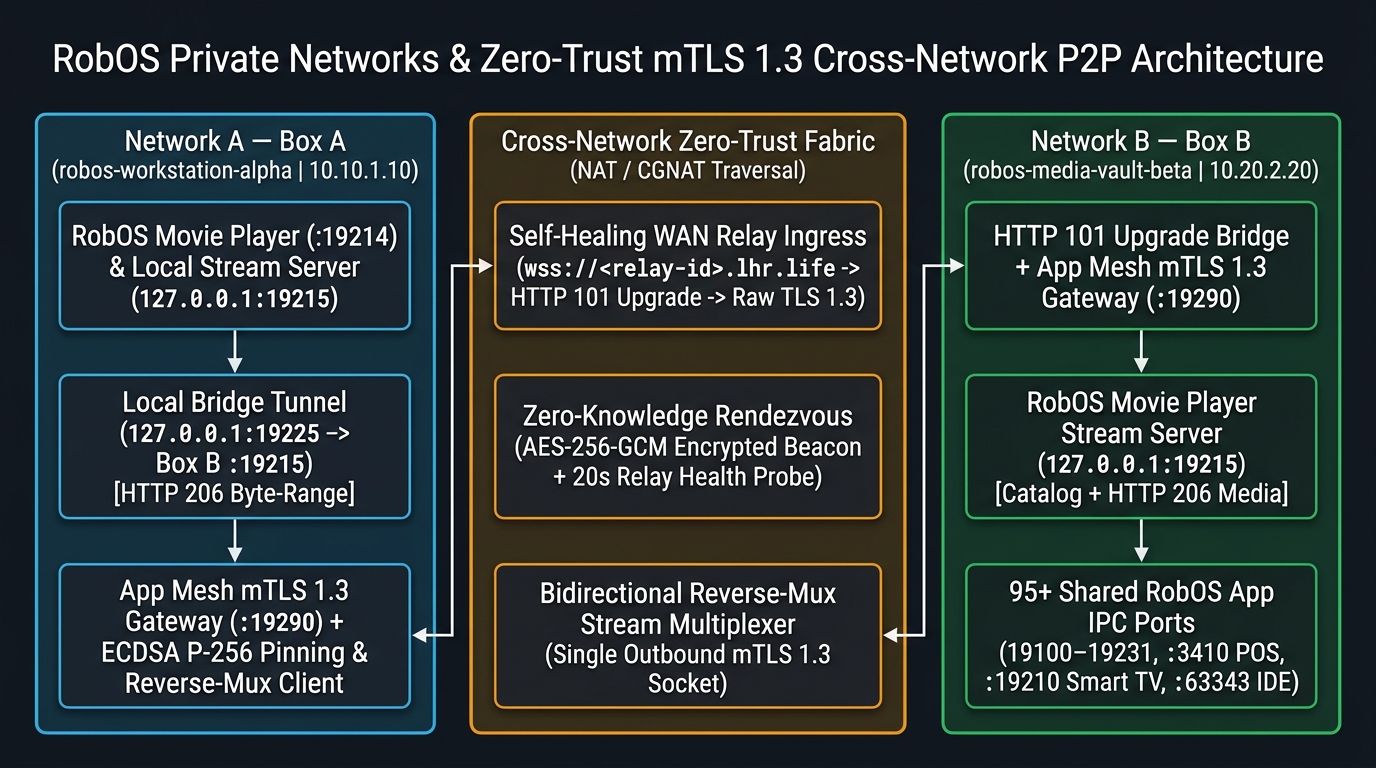
flowchart LR
subgraph NetA["Network A — Box A (robos-workstation-alpha | 10.10.1.10)"]
direction TB
MPA["RobOS Movie Player (:19214)<br/>& Local Stream Server (127.0.0.1:19215)"]
TUN["Local Bridge Tunnel (127.0.0.1:19225)<br/>Mounts Box B :19215 [HTTP 206 Byte-Range]"]
GWA["App Mesh mTLS 1.3 Gateway (:19290)<br/>ECDSA P-256 Pinning & Reverse-Mux Client"]
MPA --> TUN
TUN --> GWA
end
subgraph Fabric["Cross-Network Zero-Trust Fabric (NAT / CGNAT Traversal)"]
direction TB
RELAY["Self-Healing WAN Relay Ingress<br/>wss://<relay-id>.lhr.life → HTTP 101 Upgrade<br/>Forwards Raw Encrypted TLS 1.3 Bytes"]
RV["Zero-Knowledge Rendezvous Discovery<br/>HMAC-SHA256 Opaque Topic + AES-256-GCM Beacon<br/>+ 20s Active Relay Health Probe"]
MUX["Bidirectional Reverse-Mux Multiplexer<br/>Multiplexes Inbound & Outbound Streams<br/>Over Single Authenticated mTLS 1.3 Socket"]
end
subgraph NetB["Network B — Box B (robos-media-vault-beta | 10.20.2.20)"]
direction TB
UPG["HTTP 101 Upgrade Bridge +<br/>App Mesh mTLS 1.3 Gateway (:19290)"]
MPB["RobOS Movie Player Stream Server (127.0.0.1:19215)<br/>Cinema Catalog (/api/tv-library) + HTTP 206 Media"]
IPCB["95+ Shared RobOS App IPC & Service Ports<br/>19100–19231, :3410 POS, :19210 Smart TV, :63343 IDE"]
UPG --> MPB
UPG --> IPCB
end
GWA <-->|End-to-End Mutual TLS 1.3| RELAY
RELAY <-->|Raw TLS 1.3 Passthrough| UPG
GWA <.->|Decrypts Rotated Relay URL| RV
UPG <.->|Publishes AES-256-GCM Beacon| RV
GWA <-->|Bidirectional Stream Framing| MUX
MUX <-->|Reverse-Dial Across CGNAT| UPG
Key Capabilities
1. 1-Step Mutual Enrollment (robos-net://)
A single robos-net:// token contains the host node’s random cryptographic nodeId, gateway port, optional WAN relay URL, X.509 SHA-256 certificate fingerprint, and a secret enrollToken. When Box A runs join:
- Box A pins Box B’s X.509 SHA-256 fingerprint locally.
- Box A dials Box B over TLS 1.3 (
minVersion: 'TLSv1.3') and presentsenrollProof = HMAC-SHA256(enrollToken, nodeIdA + ":" + fingerprintA). - Box B verifies
enrollProofin constant time (crypto.timingSafeEqual) and automatically pins Box A’s client certificate—completing mutual enrollment in a single round-trip.
2. Self-Healing WAN Relay & Zero-Knowledge AES-256-GCM Rendezvous
When two RobOS machines sit on separate networks behind NAT or CGNAT without a shared overlay VPN:
- End-to-End TLS 1.3 over HTTP 101 Upgrade (
ensureUpgradeBridgeServer): The host starts a lightweight local HTTP 101 WebSocket Upgrade bridge in front of its TLS 1.3 gateway and allocates an outbound SSH relay (wss://<relay-id>.lhr.life). The relay only forwards raw TCP frames; Mutual TLS 1.3 terminates strictly inside the RobOS gateway. - 20-Second Self-Healing Health Probe (
probeRelayHttpAlive): Continuously probes the relay ingress and automatically respawns a fresh tunnel if the upstream relay drops or rotates its subdomain (HTTP 502). - Zero-Knowledge
AES-256-GCMRendezvous Discovery (publishRendezvousBeacon/resolveLatestRendezvousRelay): Whenever a relay subdomain rotates, the host publishes anAES-256-GCMencrypted beacon ({ v: 2, iv, tag, ct }) to an unguessable topic derived viaHMAC-SHA256(enrollToken, "robos-rv-topic:" + nodeId). No hostnames, LAN/Overlay IPs, node IDs, or plaintext relay URLs are ever exposed on the rendezvous channel.
3. Bidirectional Reverse-Mux Stream Multiplexing
Because Box A may also be behind strict NAT/CGNAT, joinPrivateNetwork automatically opens a persistent reverse-mux session (attachStreamMux) over the authenticated TLS 1.3 socket. Using a compact 9-byte binary frame protocol (OPEN, DATA, CLOSE, PING), Box B can dial Box A’s local ports (:19215 Movie Player, :19100–19231 App IPC) back through Box A’s outbound connection.
4. Cross-Network Movie Player Streaming (:19215 → :19225)
Linking two machines automatically mounts the remote peer’s RobOS Movie Player stream server (:19215) onto local port 127.0.0.1:19225 and writes ~/.config/robos/movie-player/active-peer-bridge.json.
- RobOS Movie Player (
packages/movie-player) auto-detects the active bridge (or lets you click+ P2P Peerin the Library Folders panel), imports the remote peer’s video catalog (/api/tv-library?all=1), rewrites media URLs tohttp://127.0.0.1:19225/media/..., and streams 1080p/4K.mp4,.mkv, and.webmfiles with instantHTTP 206 Partial Contentbyte-range seeking.
CLI & Desktop Usage
# 1. On Box B (Host): Start the Zero-Trust mTLS 1.3 Gateway, local :19215 video server, and WAN Relay
node packages/private-networks/cli.js host

# 2. On Box A (Remote Peer): Join Box B's Private Network and mount its video library on 127.0.0.1:19225
node packages/private-networks/cli.js join "robos-net://<INVITE_TOKEN>"

# 3. Query Box B's video catalog and test HTTP 206 byte-range streaming over the local mTLS bridge
curl -s "http://127.0.0.1:19225/api/tv-library?all=1" | jq .
curl -I -H "Range: bytes=0-65535" "http://127.0.0.1:19225/media/<STREAM_FILE>.webm"

# 4. Launch the Desktop GUIs
electron packages/private-networks
electron packages/movie-player
More in Security & Credentials

DocuVault Desktop
Offline-first secure markdown notes, personal snippet vault, and local workstation storage starter app.

Git Login Manager
Checks that GitHub access works (gh login, SSH key, SSH connection, git identity) and walks you through fixing what fails.

Pass Manager Vault
Desktop front end for the standard Unix password store (pass), with entries encrypted by GPG.

Pass Unlock Daemon
Small dialog that asks for your GPG passphrase once a day and caches it in gpg-agent.

RobOS App Mesh
Zero-Trust App & IPC Port Mesh for connecting RobOS applications across machines (mTLS 1.3, OpenZiti, Tailscale, NetBird, WireGuard)

RobOS Cloud Accounts
One list of your cloud accounts, shared with Data Sources and Google Calendar; Google accounts can sign in through the browser and be written into Thunderbird.

RobOS Hardware Keys
YubiKey & FIDO2 physical push keys, touch verification, ed25519-sk SSH keys, Passkeys, and PAM U2F security studio

RobOS Setup Wizard
Eleven-step first-run wizard for GPG, pass, pinentry, git identity, SSH, Chrome, GitHub login, AI agent keys and optional tools.

RobOS VPN Sandbox
Launch any desktop or CLI app inside an isolated Linux network namespace (ip netns) routed exclusively through OpenVPN with a 3-barrier kernel kill-switch.

RobOS VPN Servers
Manage OpenVPN providers (IPVanish built-in with 3,598 server profiles), encrypted VPN accounts, live TLS 1.3 credential tests, and server locations.

Security Setup Wizard
Five-step wizard that configures GPG pinentry, a GPG key, the pass store and an SSH key.