
Done right, AI puts less strain on data centers.
Today, every new app asks a giant computer to rewrite things that were solved long ago. Solve each task once and reuse it everywhere: a shared catalog of finished building blocks, and a small AI on your own laptop that snaps them together. Fewer trips to the data center, if we get it right.
A proposal, not a product. What exists today, and what doesn't
In plain words
Four ideas, no jargon
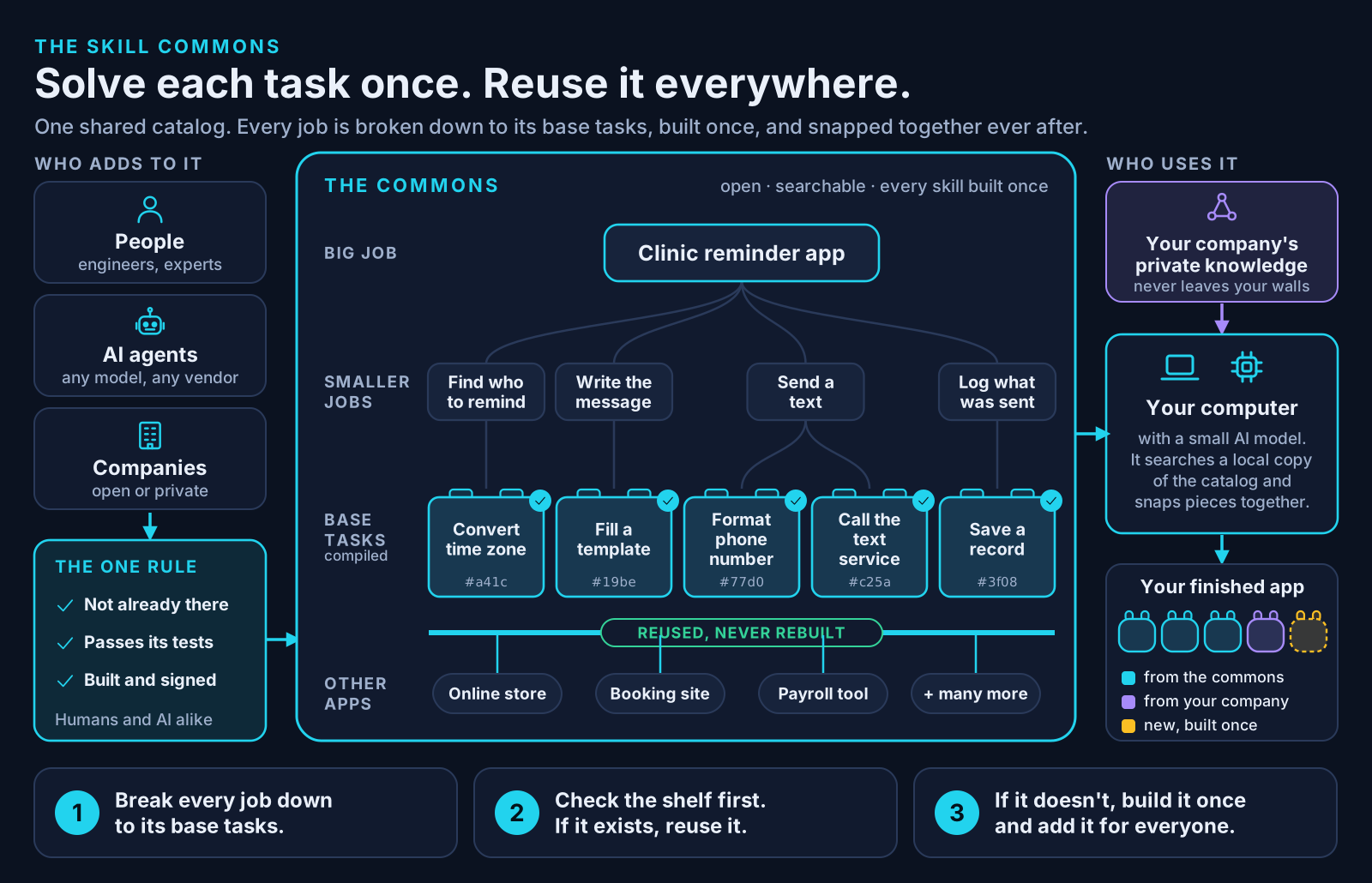
Software is built from jobs: send a text, check a card number, convert a time zone. Almost every one of them has been done before, thousands of times. The Skill Commons stops us doing them over.
Break it down
Every job is split into smaller jobs, all the way down to base tasks that can't usefully be split further.
Look before you build
Before anything is made, search the catalog. If it already exists, reuse it. Nothing is redone.
Build once, share with everyone
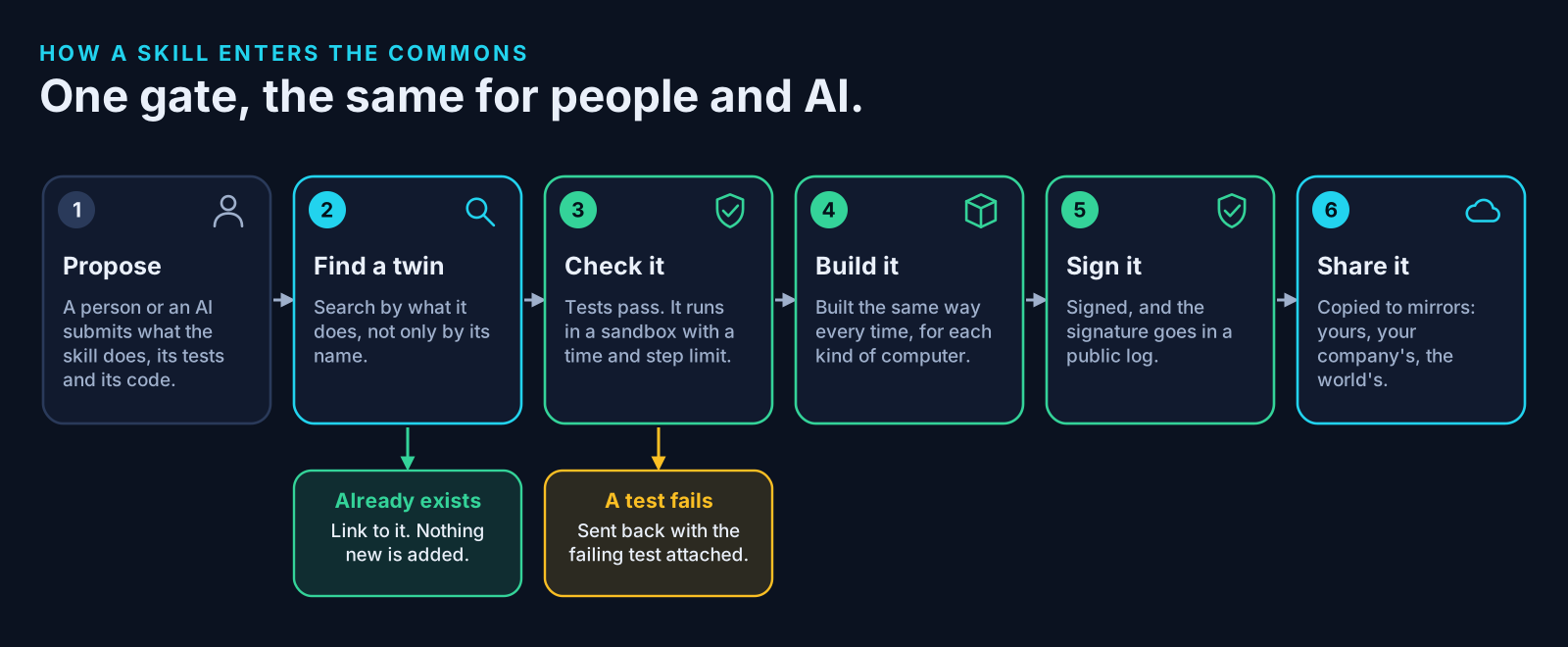
If it truly doesn't exist, a person or an AI builds it once. It is tested, signed and compiled, then added for all.
Snap it together at home
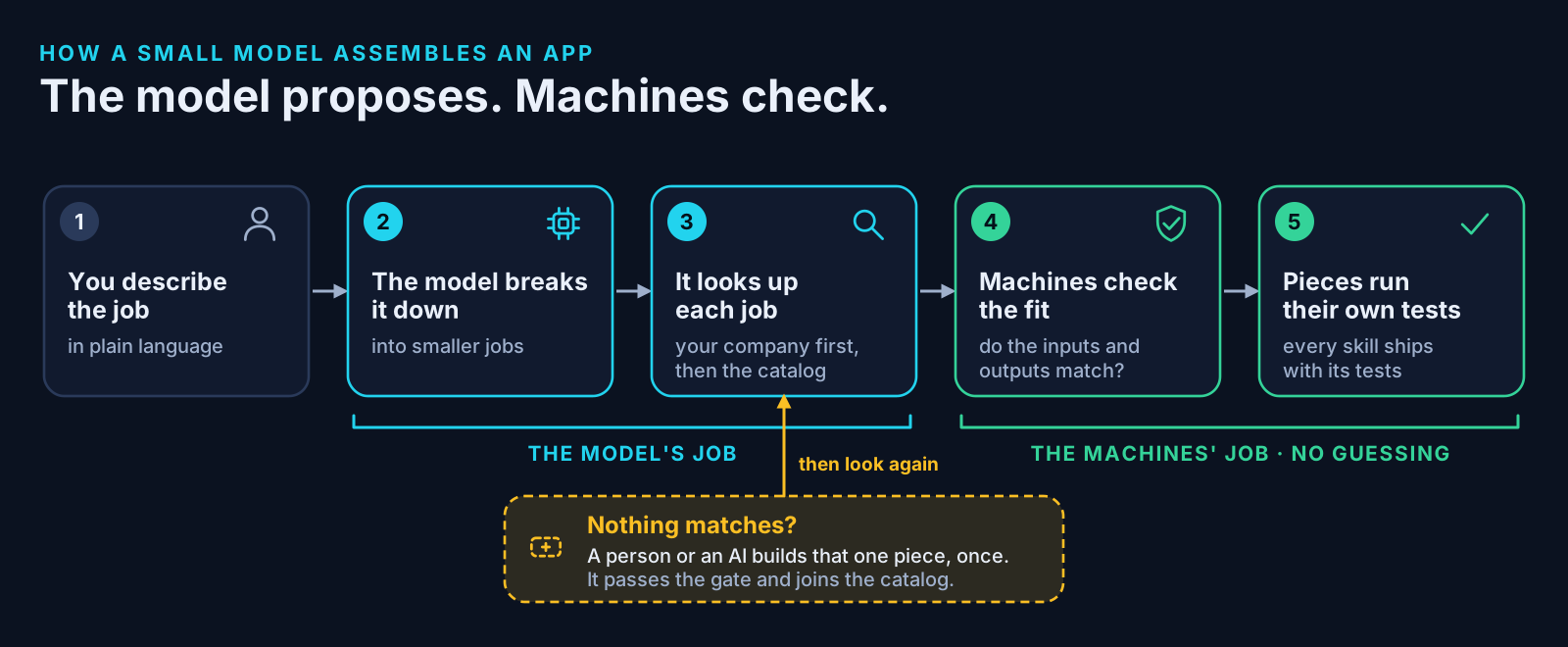
A small AI on your own computer finds the pieces and connects them. Machines check that they fit.
Why it matters
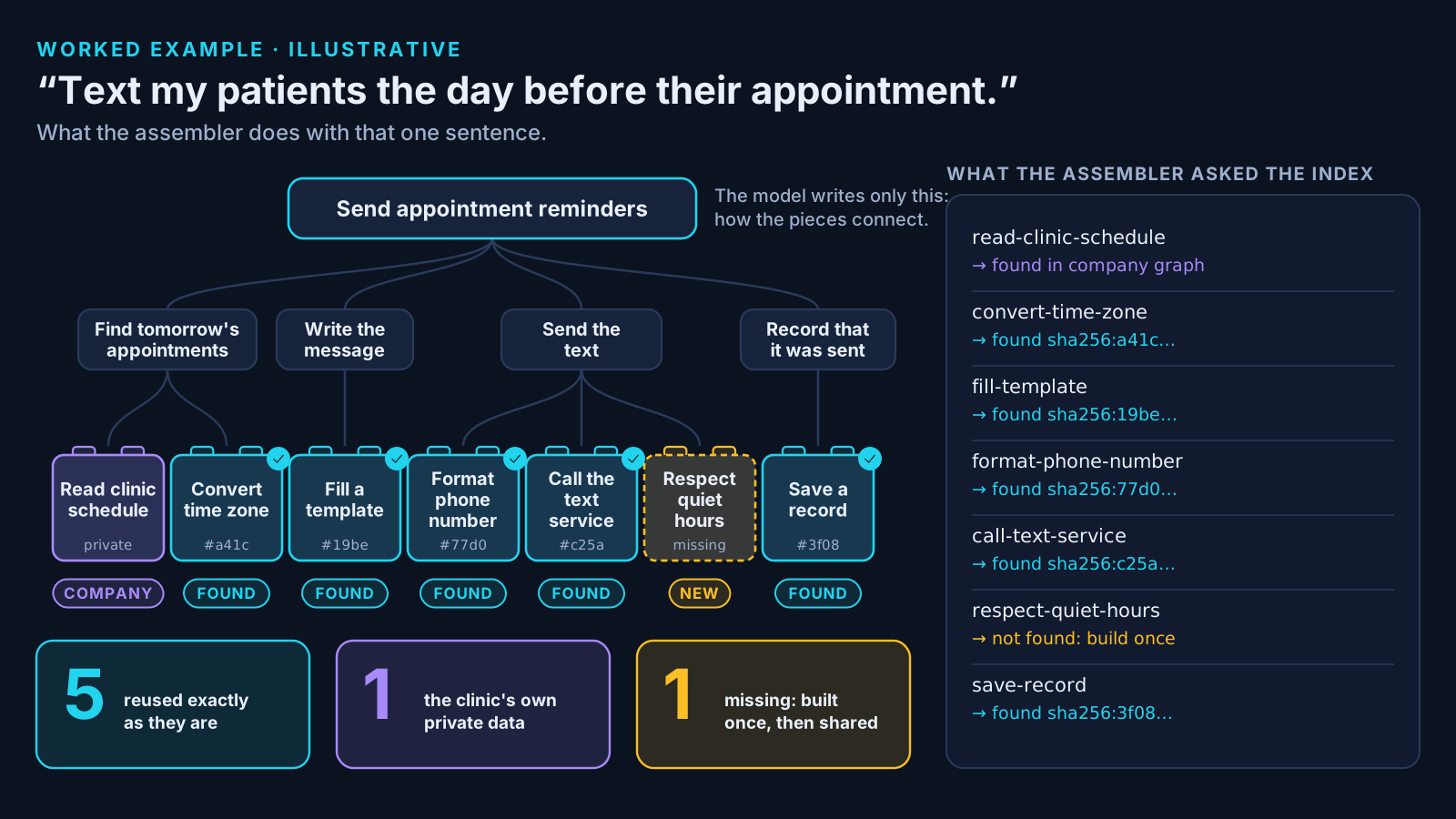
Less strain, less waste, and it stays yours
- Less strain on data centers. Routine work moves from giant shared machines to small models on your own computer. That is the goal; the paper says how we would measure whether it happens.
- Less rework. Solved problems stay solved. New effort goes to problems nobody has solved yet.
- Tested once, trusted everywhere. A piece is checked carefully one time, then used by everyone.
- Runs on your own machine. A small local model can assemble from the catalog, so ordinary work needn't go to a data center.
- Your knowledge stays private. Your company's own pieces sit on a private shelf beside the shared one.
- Open to everyone. People and AI add to the catalog through the same gate.
Is this real?
An honest status
This is a proposal. The catalog does not exist yet, and no consortium runs it. Most of the ideas are borrowed from systems that already work; what's untested is the combination.
Exists in RobOS
- Skill files that tell AI agents how to do a task
- A knowledge graph of your systems, with validation
- A search bridge over that graph
- Disposable sandboxes and video proof for agent changes
Not built yet
- The shared catalog and its gate
- Compiling, signing and mirroring skills
- The small-model assembler
- Any governing body
The whitepaper includes a plan for finding out whether the idea works, and says what would prove it wrong. We would rather find that out early.
Questions
What people ask first
Does this mean we won't need AI any more?
No. New problems always need new work, and AI will help build the new pieces. What changes is that everyday assembly no longer needs a giant model. A small local one is enough, if the plan in the paper holds up.
Isn't this just a package manager?
Package managers are the closest relative, and the paper credits them. They hand you whole libraries by name and language. The commons indexes single tasks by what they do, whatever language they were written in, and refuses to add one that already exists.
Who runs the catalog?
Nobody yet. The paper proposes a neutral non-profit foundation, as other open infrastructure has. Anyone could also keep a full copy, so a company or country can keep working offline.
Can anyone add to it?
Yes, people and AI agents, through one gate: it must not already exist, pass its tests, and be built and signed. No one is trusted or distrusted because of what wrote the code.
What stops someone sneaking in something harmful?
Nothing makes a shared catalog completely safe. The paper describes layers: reproducible builds, signatures and a public log, stronger review for widely used pieces, and sandboxes that confine what each piece may do.
How can I help?
Read the paper and tell us where it is wrong. Join the discussion on GitHub.
Read the full paper
The evidence, the design, the limits, and a plan to test it.