RobOS Projects: Real-World Applications & Systems
Explore production-grade applications, games, and distributed systems architected, scaffolded, and governed autonomously by RobOS and its AI agents.
Table of contents
Overview
In traditional software development, autonomous AI coding assistants often produce fragile, disconnected prototypes that break outside simple sandbox scripts. RobOS transforms AI agents from isolated script writers into Lead System Engineers governed by formal Knowledge Graph schemas, strict architectural boundaries, and verifiable video proof-of-work.
The RobOS Projects portfolio showcases complex, multi-subsystem applications built from scratch using the RobOS AI-First SDLC Platform:
- Polyglot backend microservices and distributed REAPI v2 build clusters.
- Developer tools, database managers, and IDE review bridges.
- Rich interactive 2D/3D games featuring Real-Time with Pause (RTwP) combat, collision pathfinding, and autonomous AI playthrough harnesses.
Featured Flagship Projects
1. The Gig Bandit & Get ‘Em Gigs (getemgigs.com)
| Project Name | The Gig Bandit & Get ‘Em Gigs (getemgigs.com) |
| Engine / Profile | Next.js 15 App Router & Vercel Edge Runtime |
| Language & Stack | React 19, JavaScript (ESM), TailwindCSS, Vercel Serverless |
| Ontology & Standard | Schema.org schema:WebApplication, RobOS robos:FrontEndApp, C4 c4:Container |
| Core Innovations | Buddy Gig Geolocation Escrow & Venue Stay-To-Play Reciprocal Booking |
| Testing Harness | Native Node.js Test Runner, Haversine Geofence Verification, Escrow State Engine |
| Verification Score | 3 Suites, 6 Tests (100% Passed) |
| Live Production | https://getemgigs.com (thegigbandit.vercel.app) · Deploy to Vercel · GitHub |
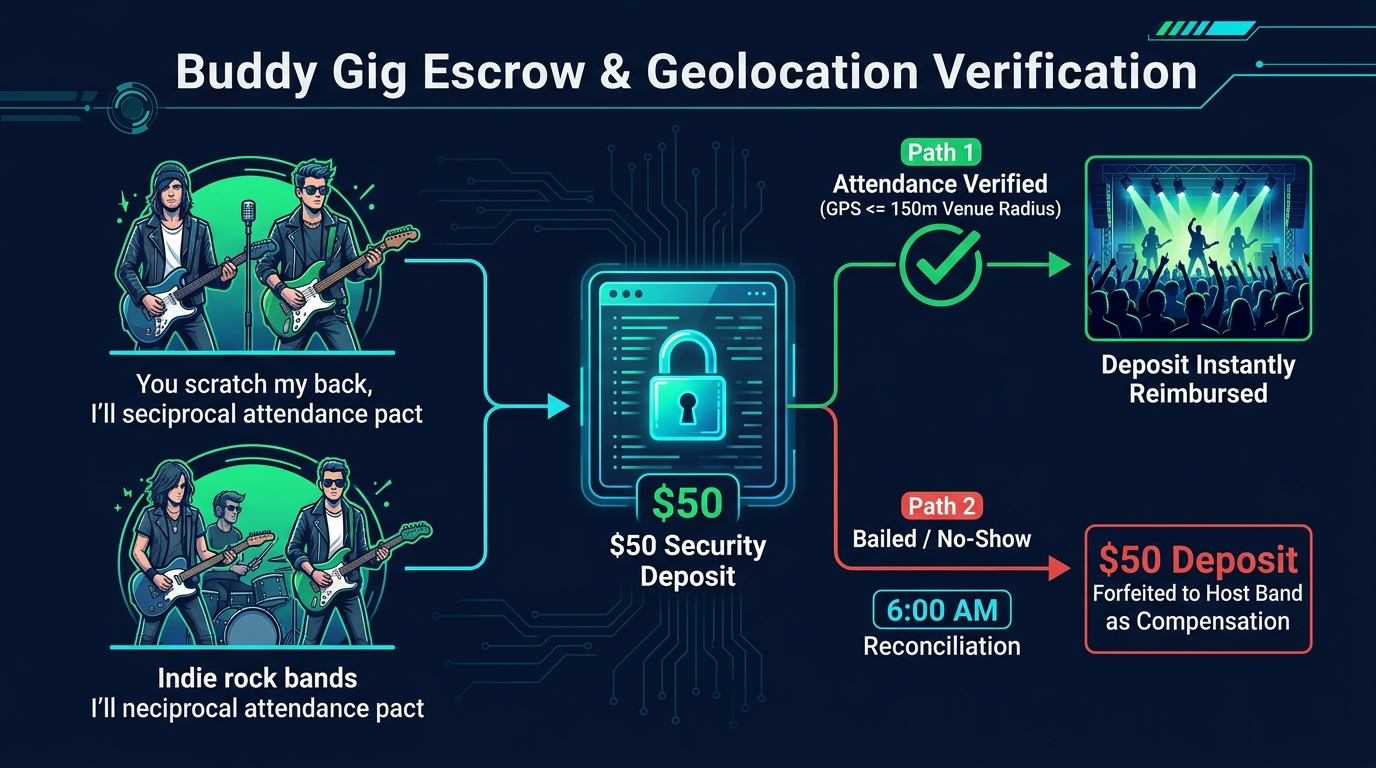
Figure: Reciprocal Buddy Gig attendance agreement, escrow deposit locking, and automated geolocation verification.
2. Tactical cRPG & Infinity AI Engine
| Project Name | Tactical cRPG Realm (crpg-realm) |
| Engine / Profile | Godot 4.3 (GL Compatibility) |
| Language & Stack | GDScript (typed), Python 3.12+ (behave), FFmpeg |
| Ontology & Standard | Schema.org schema:VideoGame, RobOS robos:PCGame, D&D 5e SRD |
| Testing Harness | Dual E2E Suite: 11 Isolated Features + 6 Start-to-Finish Playthrough Scenarios |
| Verification Score | 17 Features, 28 Scenarios, 482 Steps (100% Passed) |
flowchart LR
    subgraph KG_LAYER ["Knowledge Graph and Schemas"]
        KG["crpg_game_v1.schema.json"] --> DS["data/v1/ (Classes, Spells, Monsters, NPCs)"]
        DS --> GD["src/generated/v1/DataStoreV1.gd"]
    end

    subgraph ENGINE_LAYER ["Godot 4.3 Runtime Engine"]
        GD --> World["5-Act Epic Campaign Scenes"]
        World --> RTwP["RTwP Combat & Round Timer (6.0s)"]
        World --> Phys["StaticBody2D Colliders & Pathfinder.gd"]
        World --> ActLog["3-Mode Infinity Engine Activity Log"]
    end

    subgraph QA_LAYER ["Autonomous QA and Verification"]
        HTTP["GameControlServer (HTTP :18090)"] <--> AI["Infinity AI Agent (qa_player)"]
        AI --> BDD["Cucumber BDD Scenarios (17 Features)"]
        BDD --> Video["1080p Video Proof-of-Work (FFmpeg + Xvfb)"]
    end

    World <--> HTTP
Project Directory
🎸 The Gig Bandit & Get 'Em Gigs
A game-changing web platform for the local music scene deployed to getemgigs.com on Vercel. Solves empty rooms and predatory pay-to-play with the Buddy Gig Geolocation Escrow ("You scratch my back, I'll scratch yours") and Venue Stay-To-Play reciprocal ticket economics.
⚔️ Tactical cRPG & Infinity AI Engine
A party-based tactical isometric cRPG built in Godot 4 inspired by classic Infinity Engine masterpieces (Baldur's Gate, Icewind Dale). Features D&D 5e SRD rules, 5-Act Epic Campaign, physical building collision, 18 unique NPCs with branching dialogue, and autonomous AI questing.
What Makes a RobOS Project Different?
- Dual-State Knowledge Graph First: Every entity (classes, spells, monsters, NPCs, items, maps) is modeled as typed JSON-LD backed by W3C SHACL shape constraints. Changes trigger semantic blast-radius analysis before any code is committed.
- Autonomous End-to-End Verification: Rather than relying on fragile unit assertions or mocked unit tests, RobOS projects are verified in virtual framebuffers (Xvfb) via real user-simulation agents producing 1080p video walkthroughs.
- Clean Code Generation: Engine data stores and data models are auto-generated from JSON Schemas, eliminating hardcoded constants and runtime type errors.
- Agent-Agnostic Governance: The project structure allows Claude Code, Google Antigravity, GitHub Copilot, and OpenAI Codex to collaborate on the exact same codebase without configuration drift.